An Essential Guide to How a 20-30 Year Old Garage Door Compares in Durability
Dad And Daughter Garage Door Service

Learn how a 20 to 30 year old garage door compares to modern options in durability, safety, and value—decide whether repair or replacement is right…
An Essential Guide to How a 20-30 Year Old Garage Door Compares in Durability
What Separates a 20-30 Year Old Garage Door From Modern Options in Durability
If you’re wondering how a 20 to 30 year old garage door compares to modern options in durability, here’s the short answer: older doors fall significantly behind. Aging doors were typically built from a single thin layer of steel or untreated wood, with little to no insulation and no advanced safety features. Modern doors use multi-layer sandwich construction, high-performance insulation cores, and materials engineered to resist denting, warping, rust, and UV damage far longer.
Quick comparison at a glance:
| Feature | 20-30 Year Old Door | Modern Door |
|---|---|---|
| Construction | Single-layer (pan style) steel or bare wood | Multi-layer sandwich (steel + insulation + steel) |
| Insulation (R-value) | Minimal to none | R-6 to R-20+ |
| Typical lifespan | Nearing or past end of life | 20-30+ years from installation |
| Safety features | Often missing auto-reverse sensors | Auto-reverse, photo-eye, pinch-resistant panels |
| Material durability | Fatigued, prone to rust, rot, or warping | Protective coatings, galvanized steel, UV-resistant finishes |
| Maintenance demands | High — frequent repairs likely | Lower with proper annual upkeep |
| Energy efficiency | Poor — significant heat loss or gain | Strong — reduces HVAC load in attached garages |
Most garage doors are built to last between 15 and 30 years, depending on material, maintenance, and climate. A door installed in the mid-1990s to early 2000s is either at or well past that window. And even if it still opens and closes, the materials underneath are likely fatigued in ways that aren’t always visible.
This guide walks through exactly where older doors fall short — from structural integrity and insulation to safety standards and long-term repair costs — so you can make a clear-eyed decision about what your home actually needs.
How a 20 to 30 Year Old Garage Door Compares to Modern Options in Durability
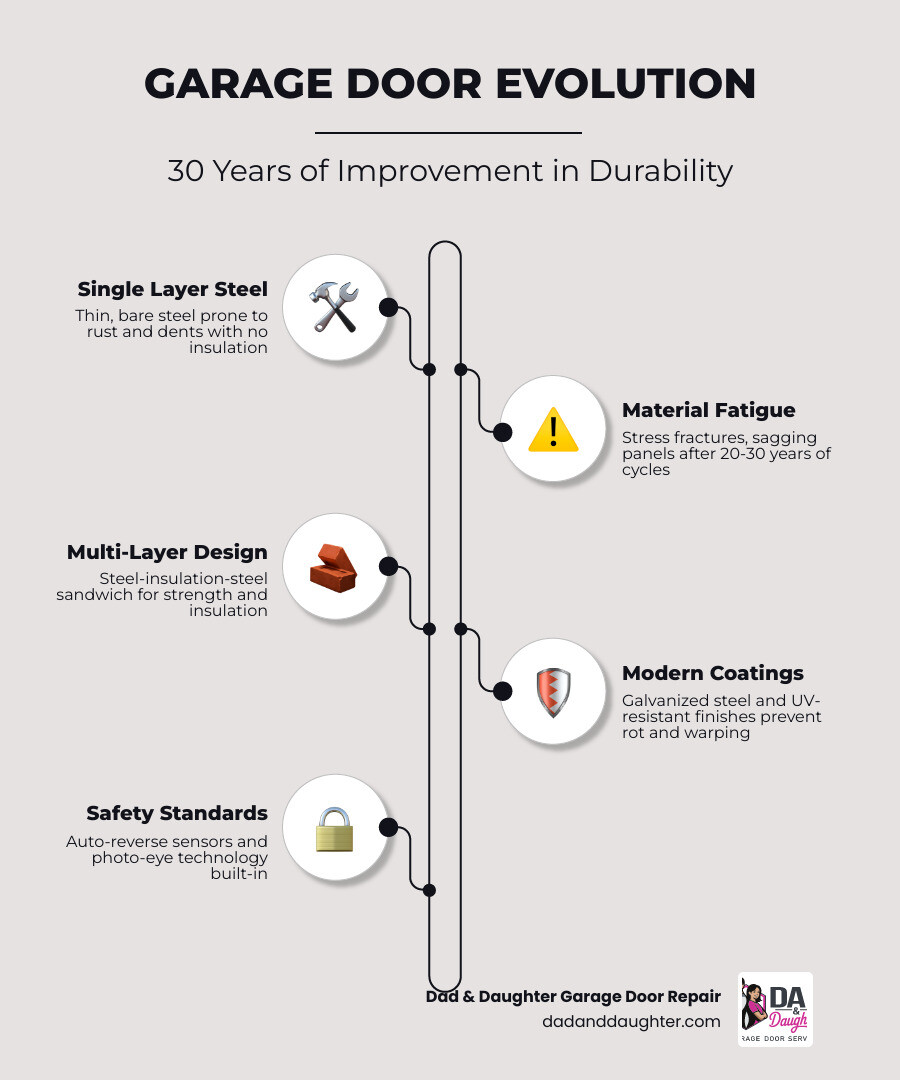
When we look at a garage door that has survived 20 to 30 years on a home in Tennessee, we are looking at a survivor. However, the structural integrity of a door from the late 1990s is fundamentally different from what is manufactured today. Over three decades, the constant cycles of opening and closing, combined with exposure to humid Tennessee summers and freezing winter nights, take a toll on the physical composition of the door panels.
Material fatigue is a primary issue for older garage doors. Every time a garage door bends and moves along its tracks, the metal or wood experiences microscopic stress. Over 20 to 30 years, this stress accumulates. In older steel doors, this often manifests as hairline fractures around the hinges, sagging in the center of the panels, or bowing when the door is in the open position.
Wind load resistance is another critical area of comparison. Modern building codes require garage doors to withstand significant wind pressures, particularly in storm-prone areas across Nashville, Knoxville, and Chattanooga. Older doors were rarely engineered to meet modern wind load standards. A 30-year-old single-skin door can easily buckle under high winds, potentially blowing inward and exposing the rest of your home to severe structural damage.
To help visualize how the basic physical makeup has evolved, we can look at our resource on Garage Door Comparisons to see how different design styles perform over time. Below is a detailed look at how vintage single-skin (or “pan”) doors compare structurally to modern multi-layer “sandwich” doors.
| Structural Attribute | Vintage Single-Skin “Pan” Doors (20-30 Years Old) | Modern Multi-Layer “Sandwich” Doors |
|---|---|---|
| Panel Construction | A single thin sheet of non-galvanized or lightly treated steel. | Three-layer construction: steel exterior, dense insulation core, steel interior backing. |
| Structural Rigidity | High risk of bowing, sagging, or snapping in half under pressure. | Feels like a solid wall; highly resistant to warping, twisting, and physical impact. |
| Joint & Hinge Reinforcement | Minimal reinforcement; screws frequently strip out of the thin metal over time. | Built-in steel backup plates at all hinge attachment points for maximum hold. |
| Wind & Weather Resistance | Prone to rattling, buckling, and letting drafts blow straight through the seams. | Engineered to meet strict wind-load ratings with tight, interlocking joint profiles. |
Material Strength: How a 20 to 30 Year Old Garage Door Compares to Modern Options in Durability
The raw materials used to manufacture garage doors have undergone a massive technological shift. If your existing door was installed around 1996, it was likely built using basic, single-layer steel or traditional solid wood.
Older steel doors relied on thin-gauge metal. Over time, as the factory paint wore off, these doors became highly susceptible to rust, especially along the bottom panel where rain, snow, and road salt collect. Modern steel doors, by contrast, utilize hot-dipped galvanized steel layers, baked-on primers, and advanced polyester topcoats. This multi-stage finishing process ensures that modern steel remains rust-free for decades with minimal maintenance.
Wooden doors from 20 to 30 years ago carry unmatched natural beauty, but they require a lifetime commitment to maintenance. Without regular sanding, painting, or sealing every two to three years, moisture inevitably penetrates the wood. This leads to rot, warping, and swelling. A warped wood door doesn’t just look bad; it actually gets heavier and misaligned, which can burn out your opener motor or cause the track system to bind.
Modern synthetic materials have completely changed the durability landscape. Consider these options available in our Garage Door Products lineup:
- Vinyl with “Memory”: Modern PVC and vinyl doors are highly resilient. Unlike steel, which dents permanently when hit by a stray basketball, high-quality vinyl possesses a “memory” that allows it to flex and snap back into its original shape.
- Fiberglass Advancements: Older fiberglass doors from decades ago were notorious for yellowing, cracking, and becoming brittle under intense UV exposure. Today’s fiberglass composites use advanced UV-inhibiting topcoats that prevent fading and cracking, making them an excellent choice for homes that face direct, harsh sunlight.
Component Wear: How a 20 to 30 Year Old Garage Door Compares to Modern Options in Durability
A garage door is a complex mechanical system, and its overall lifespan is only as good as its weakest component. While the door panels themselves might look decent from the street, the mechanical hardware supporting them is likely exhausted after 20 to 30 years of daily service.
The most critical mechanical components are the springs, which do the heavy lifting of raising and lowering the door. Standard torsion springs are rated for approximately 10,000 cycles. If your household opens and closes the garage door four times a day, that spring will reach its limit in about seven to ten years.
This means a 20- to 30-year-old door has likely gone through multiple spring replacements, or worse, is currently operating on an ancient, fatigued spring that is a ticking time bomb. When an old spring snaps, it does so with a loud pop and can cause the heavy door to crash down instantly, posing a severe safety risk. To understand the differences in modern spring engineering, you can read our breakdown of Torsion vs Extension Garage Door Springs Knoxville TN.
Other mechanical parts like rollers, hinges, and tracks also fatigue over decades of use:
- Rollers: Older doors often use unsealed steel rollers. Over the years, dirt and moisture get trapped inside the bearings, causing them to seize up. Instead of rolling smoothly, they slide along the track, creating a loud screeching sound and putting massive strain on the opener. Modern nylon rollers feature sealed ball bearings that operate quietly and require zero lubrication.
- Hinges: Vintage hinges made of thin-gauge steel eventually bend or develop play in the joints, causing the door panels to sag and bind during operation.
- Tracks: Over 30 years, tracks can become misaligned, rusted, or bent out of shape due to house settling or minor accidental bumps.
Construction Quality, Insulation, and Safety Standards

The physical construction of a garage door has evolved from simple barrier panels to highly engineered thermal envelopes. Decades ago, garage doors were rarely insulated. If they did have insulation, it was usually a simple sheet of polystyrene taped or glued to the back of a single steel panel, leaving the raw insulation exposed to damage.
Today, high-quality modern doors utilize “sandwich” construction. This means a dense core of insulation is pressurized and injected between two heavy-duty steel skins.
There are two primary types of insulation used in modern doors:
- Polystyrene: Rigid foam panels inserted into the door sections. While effective, it leaves minor air gaps between the foam and the steel.
- Polyurethane: A liquid foam injected directly into the panel core. It expands to fill every crevice, bonding the front and back steel sheets together. This creates an incredibly rigid, solid panel that feels like a structural wall and offers superior dent resistance.
This insulation is measured in R-value, which represents thermal resistance. Older doors have an R-value of near zero, acting as a massive radiator that transfers Tennessee heat into your home during July and lets freezing air in during January. Modern polyurethane-insulated doors can achieve R-values exceeding R-18, significantly reducing the workload on your home’s HVAC system if you have an attached garage.
Safety standards have also undergone a massive shift over the last thirty years. In 1993, federal law mandated that all residential garage door openers be equipped with external safety reversal systems, such as photo-eye sensors. If your opener system is nearing 30 years of age, it may be operating on outdated technology that lacks these essential safety sensors, or the sensors themselves may be failing due to degraded wiring.
Furthermore, modern doors feature pinch-resistant panel designs. The joints between the panels are engineered so that if a child puts their fingers in the seams while the door is closing, their fingers are pushed outward rather than crushed. If you are debating whether to keep patched-up old hardware or invest in a reliable modern setup, our guide on the Repair vs Replace Garage Door Motor Nashville TN offers valuable insights into making a safe, logical choice.
Maintenance Needs, Repair Frequency, and Long-Term Value
Owning a 20- to 30-year-old garage door is often like driving a high-mileage classic car: it has character, but you are constantly waiting for the next part to break. The older a door gets, the more frequent and expensive the repairs become.
At a certain point, homeowners face a cycle of cascading failures. You replace a broken spring, only for the extra tension to wear out the ancient rollers. You replace the rollers, and then the fatigued hinges bend. A few months later, the old opener motor burns out from years of lifting an imbalanced door.
When evaluating these ongoing issues, we recommend using the 50 percent rule. If a single repair estimate or the combined cost of anticipated repairs over a 12-to-24-month period approaches or exceeds 50 percent of the cost of a complete replacement, investing in a new system is almost always the smarter long-term choice.
A new garage door installation offers several major financial and practical advantages over keeping an old door on life support:
- Comprehensive Warranty Coverage: While repairs on an old door usually come with short-term, 30-to-90-day warranties on parts only, a new door system typically features long-term warranties on panels, paint finishes, hardware, and the motor.
- Reduced Energy Bills: High R-value insulation keeps your garage — and the rooms adjacent to it — at a more stable temperature, lowering your monthly utility costs.
- Massive Curb Appeal and Home Value Boost: The garage door can make up to 40 percent of your home’s front facade. Replacing a dented, weathered 30-year-old door with a modern carriage-house or contemporary style instantly transforms your home’s appearance. In fact, national real estate studies consistently show that a garage door replacement ranks among the top home improvement projects for return on investment (ROI), often yielding over 190% of its cost in added home value.
If you want to see how we help homeowners transition from constant repairs to trouble-free, high-performance systems, take a look at our philosophy: We Don’t Just Replace Garage Doors in Nashville TN, We Upgrade Them.
Frequently Asked Questions about Garage Door Durability
How long does a typical residential garage door last?
A well-maintained residential garage door typically lasts between 15 and 30 years. The exact lifespan depends heavily on the quality of the materials, local environmental conditions (such as Tennessee’s high humidity), how often the door is cycled daily, and whether it receives regular professional maintenance and lubrication.
What are the main safety risks of keeping a 30-year-old garage door?
The primary safety risks include:
- Sudden Spring Failure: Fatigued springs can snap violently, causing the heavy door to crash down without warning.
- Lack of Modern Safety Sensors: Pre-1993 or failing opener systems may lack reliable auto-reverse photo-eyes, creating a entrapment hazard for children and pets.
- Structural Collapse: Weakened, single-layer metal panels can buckle or blow out during high-wind events or severe storms.
- Pinch Hazards: Older panel joints can easily trap and crush fingers during operation.
Why do modern sandwich-style doors resist denting better than older pan doors?
Modern sandwich-style doors feature a triple-layer construction where a dense core of polyurethane or polystyrene insulation is sandwiched tightly between two sheets of steel. This solid core acts as a continuous support system for the outer metal skin, absorbing impacts from basketballs, bikes, or yard tools. Older pan doors consist of a single thin layer of steel with no backing, leaving them completely hollow and highly susceptible to permanent denting and creasing.
Conclusion
When comparing a 20- to 30-year-old garage door to modern options, the difference in durability, safety, and energy efficiency is night and day. While an older door may have served your family well for decades, there comes a point where continuing to repair worn-out parts is simply throwing good money after bad. Upgrading to a modern, insulated, and structurally sound garage door system is an investment that pays off immediately in improved safety, lower utility bills, reduced noise, and stunning curb appeal.
At Dad & Daughter Garage Door Repair, we have been proudly serving our neighbors across Middle and East Tennessee since 1996. As a family-owned, locally operated business with no private equity backing, we focus strictly on delivering honest advice, exceptional craftsmanship, and the personalized customer care you deserve. Whether you are located in Nashville, Knoxville, Chattanooga, Franklin, Brentwood, or any of our surrounding service areas, we are here to help you find the perfect, long-lasting solution for your home.
Ready to say goodbye to your noisy, drafty, and unreliable old door? Upgrade your home with expert garage door services in the Nashville area today, and let our family take care of yours!
Need Help?
Contact us today to discuss your needs. Our team is ready to help.
About the Author
Dad And Daughter Garage Door Service
More Articles
View All PostsRelated Articles

Why Nashville Building Codes Dictate Specific Wind Load Ratings
An unbraced garage door is the largest structural vulnerability during severe weather. See exactly what local inspectors look for to ensure your new build meets current wind load requirements.
Read Article
The Cost Difference Between Stamped Steel and Custom Wood Doors
Choosing between custom wood and steel means looking past the initial estimate. Understand the lifetime maintenance realities of each material before your next exterior upgrade.
Read Article
Preparing Your Commercial Warehouse Doors for Winter Deliveries
September is the critical window to secure your loading docks before freezing temperatures cause mechanical failures. Learn how to address degraded hardware and protect your Q4 shipping schedule.
Read ArticleReady to Get Started?
Whether you need a repair, maintenance, or a new installation, our expert team is here to help.