Detailed Guide to Belt Drive vs Chain Drive vs Screw Drive Garage Door Openers
Dad And Daughter Garage Door Service

Compare belt drive vs chain drive vs screw drive garage door opener systems to find the quietest, strongest option for your home.
Detailed Guide to Belt Drive vs Chain Drive vs Screw Drive Garage Door Openers
The Belt Drive vs Chain Drive vs Screw Drive Garage Door Opener Comparison: What Every Homeowner Should Know First
When it comes to the belt drive vs chain drive vs screw drive garage door opener comparison, the right choice comes down to three things: how much noise you can tolerate, how heavy your door is, and how much maintenance you want to do.
Here is a quick breakdown to answer your question right away:
| Drive Type | Noise Level | Best For | Lifespan |
|---|---|---|---|
| Belt Drive | Quietest | Attached garages, bedrooms above garage | 15-20 years |
| Chain Drive | Loudest | Heavy doors, detached garages, budget installs | 10-15 years |
| Screw Drive | Moderate | Heavy or oversized doors, low-ceiling garages | 10-15 years |
Quick verdict:
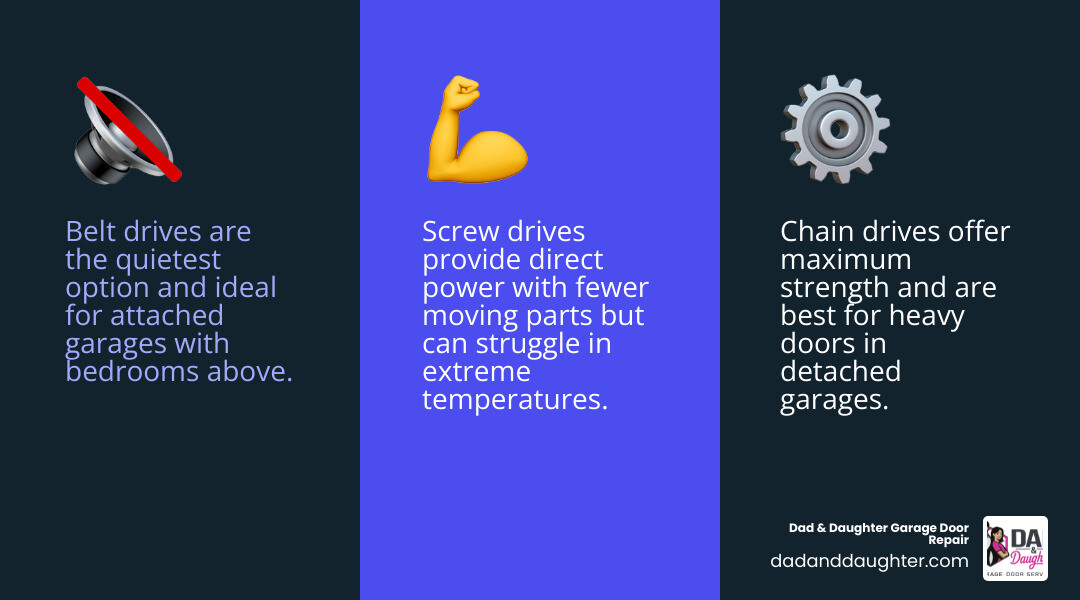
- Choose a belt drive if you have an attached garage or a bedroom near the garage and quiet operation matters to you.
- Choose a chain drive if you want the most affordable, proven option and noise is not a concern.
- Choose a screw drive if you have a heavy, wide, or oversized door and want fewer moving parts — but avoid it if you live somewhere with extreme temperature swings.
Most homeowners shopping for a new garage door opener have no idea these differences exist until the old unit breaks down and they suddenly have to make a decision fast. In your grandparents’ day, chain drive was essentially the only option. Today, belt and chain drives together account for more than 95% of all garage door opener sales, with screw drive making up the remaining 5% — a niche but powerful option for the right situation.
Each drive type has real trade-offs in noise, strength, maintenance, and climate performance. Understanding those trade-offs before you buy saves you from making a choice you will regret every morning when you hear that opener rattle through the ceiling above your bedroom.
This guide breaks down everything you need to know so you can make a confident, informed decision for your home.
Understanding the Mechanics: How Each Drive Type Works
Before we jump into the details of our comparison, it helps to take a peek inside that motorized box on your ceiling. While all residential garage door openers exist to do the exact same job, the mechanical way they transfer power from the electric motor to your garage door is completely different.
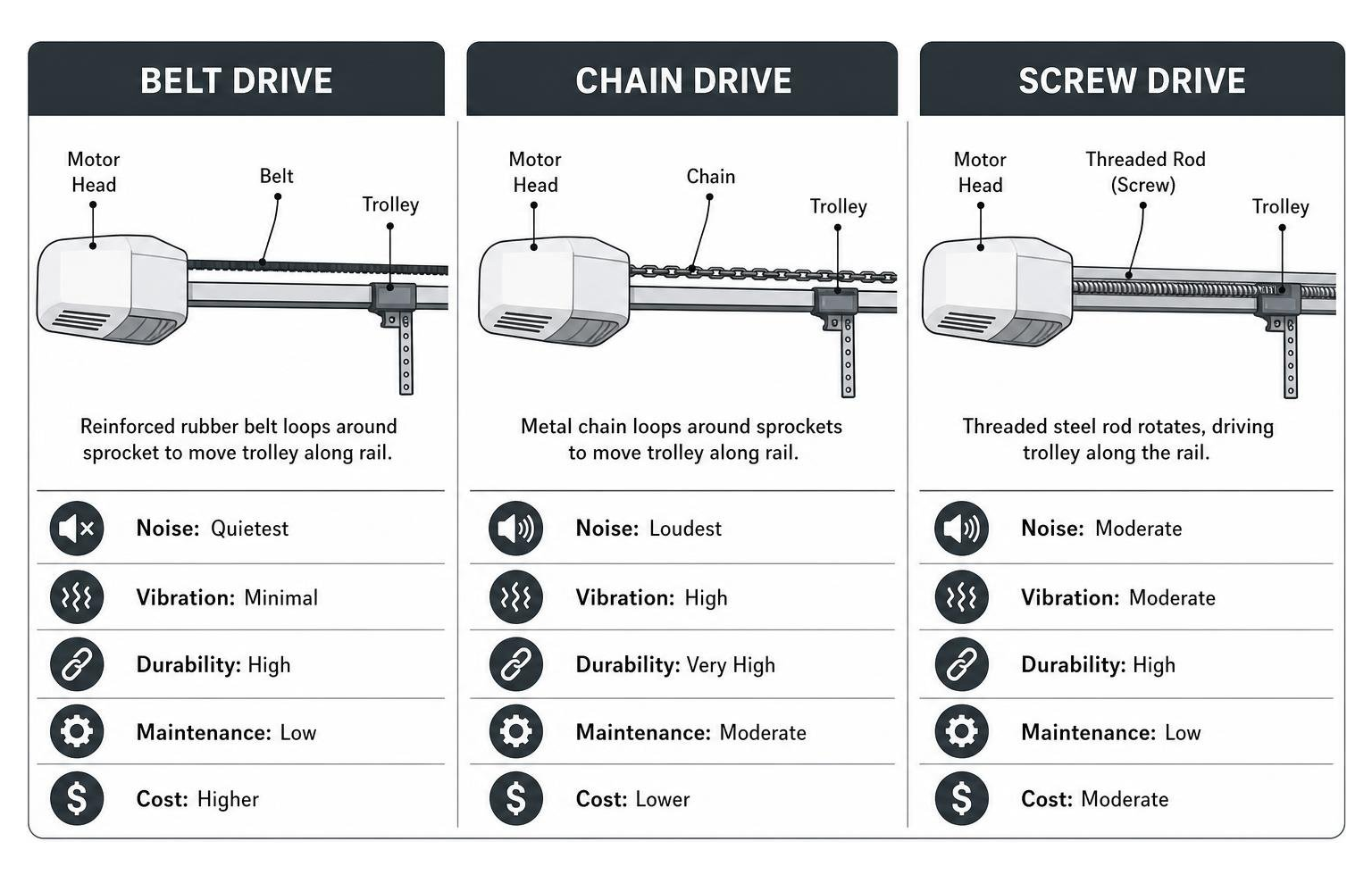
Every overhead opener relies on a central motor head that houses the electric motor and logic board. Extending from this motor head is a long metal rail. Inside or along this rail runs the drive medium (the belt, chain, or screw), which is connected to a carriage called a trolley. When the motor spins, it moves the drive medium, pulling the trolley back and forth along the rail to open or close the door.
In modern systems, the type of motor inside that housing also plays a massive role. Older units relied on alternating current (AC) motors, which run at one constant, noisy speed. Today, high-quality systems utilize direct current (DC) motors. DC motors are smaller, significantly quieter, and allow for “soft start and stop” technology, which slows the door down right as it starts or finishes its cycle to prevent jarring vibrations.
To see how these mechanical differences play out across different brands and models, you can explore our Garage Door Comparisons Category for in-depth reviews.
The Rugged Chain Drive System
The chain drive is the undisputed classic of the garage door world. It operates using a heavy-duty metal roller chain—very similar to a bicycle chain—wrapped around a drive sprocket on the motor head and an idler pulley at the end of the rail.
Because the entire mechanism is made of steel, chain drives are incredibly rugged and built to last. They do not slip, stretch, or snap easily under heavy loads. However, because metal-on-metal contact is inherent to the design, they are naturally the loudest option. As the chain links clatter against the drive sprocket and slap against the steel rail, they create a distinct grinding noise and send vibrations straight into the structural framing of your home. They are highly durable, making them the classic workhorse for detached garages, workshops, or budget-conscious installations where noise is not an issue.
The Ultra-Quiet Belt Drive System
Belt drive garage door openers are designed with the exact same layout as chain drives, with one crucial upgrade: the metal chain is replaced by a smooth, flexible belt. This belt is typically constructed from reinforced rubber, polyurethane, or fiberglass, often lined with ultra-strong internal steel cords for added durability.
By swapping out the metal chain, you completely eliminate metal-on-metal contact within the rail assembly. The rubberized belt glides silently over the sprocket and along the rail, absorbing vibrations rather than transmitting them. When paired with a modern DC motor, a belt drive operates almost silently. It is the premier choice for attached garages, particularly those with living spaces or bedrooms directly above or adjacent to the garage.
The Efficient Screw Drive System
The screw drive opener takes a completely different mechanical approach. Instead of using a looping chain or belt to pull a trolley, it features a long, solid-steel threaded rod (essentially a giant screw) running straight through the center of the rail.
A small trolley with matching internal threads grips this rod. When the motor spins, the threaded rod rotates, driving the trolley smoothly along the rail like a nut on a bolt. This direct-drive design is incredibly elegant because it has far fewer moving parts, gears, and sprockets to wear out over time. It delivers efficient power transfer and fast lifting speeds, making it a highly reliable option for heavy doors.
Belt Drive vs Chain Drive vs Screw Drive Garage Door Opener Comparison
When evaluating the belt drive vs chain drive vs screw drive garage door opener comparison, it helps to look at them side by side across the performance metrics that actually affect your daily life.
Whether you are trying to decide if you need a simple fix or a brand-new setup, understanding these performance factors is key. If you are currently dealing with a malfunctioning motor and wondering whether to fix it or upgrade to a quieter drive type, check out our guide on Garage Door Motor When to Repair vs Replace Chattanooga TN.
Noise Levels and Vibration in the Belt Drive vs Chain Drive vs Screw Drive Garage Door Opener Comparison
For many homeowners, noise is the single most important factor. If your garage shares a wall with your living room or sits directly beneath a master bedroom, a loud garage door opener can disrupt sleep and daily peace.
- Belt Drives are the undisputed quietest option on the market. By replacing the metal chain with a flexible, rubber-based belt, they eliminate the clatter of metal-on-metal contact. They typically operate at a sound level that is 50% to 70% quieter than a traditional chain drive. When combined with a soft-start/soft-stop DC motor, the only sound you will really hear is the physical movement of the garage door panels themselves.
- Screw Drives fall into the moderate noise category. While they do not have a clattering chain, they still feature a metal trolley moving along a metal threaded rod. They are noticeably quieter than chain drives, producing a consistent hum rather than a harsh rattle, but they cannot compete with the near-silence of a belt drive.
- Chain Drives are the loudest. The metal chain vibrates against the steel rail, sending a low-frequency hum and vibration through your home’s joists and drywall. While modern chain drives are quieter than those built decades ago, they still produce significant noise.
Strength and Speed in the Belt Drive vs Chain Drive vs Screw Drive Garage Door Opener Comparison
Your garage door is the largest moving object in your home. If you have a heavy double-car insulated door, a custom solid wood door, or a modern full-glass architectural door, you need an opener with serious lifting capacity and speed.
- Chain Drives are the ultimate heavy lifters. Because the steel chain has incredibly high tensile strength, it can easily handle heavy doors weighing up to 500 pounds or more without any risk of the drive medium stretching or snapping.
- Screw Drives are also exceptional for heavy doors. The direct-drive rotation of the solid-steel threaded rod transfers torque directly to the door with minimal power loss. Furthermore, screw drives are incredibly fast. While standard chain and belt openers lift at a rate of 6 to 8 inches per second, high-speed screw drive models can lift doors at up to 10 to 12 inches per second.
- Belt Drives are incredibly strong, but they do have physical limits. While modern steel-reinforced belts can easily lift standard double-car insulated steel doors, they can experience slight stretching or slipping when subjected to extremely heavy, oversized custom wood doors over long periods.
That your opener is only designed to pull a small fraction of the door’s actual weight; the heavy lifting is actually done by your springs. If your springs are worn or improperly balanced, even the strongest opener will struggle. To learn more about how your springs support your opener, read our comparison on Torsion vs Extension Garage Door Springs Knoxville TN.
Maintenance, Lifespan, and Climate Sensitivity
Every mechanical system requires some upkeep to perform reliably year after year. However, the amount of maintenance you will need to perform—and how long your opener will last—depends heavily on the drive type you select.
If you are noticing grinding noises, slow operation, or erratic behavior, it might be time to have a professional look at the motor. For homeowners in the Murfreesboro area, you can learn more about local repair options in our guide to Garage Door Motor Repair Murfreesboro TN.
How Temperature Extremes Affect Performance
Our climate in Tennessee brings hot, humid summers and cold, frosty winters. These seasonal temperature swings can have a surprising impact on your garage door opener’s mechanical components.
- Screw Drives are the most sensitive to temperature extremes. Because they rely on a long, solid-steel rod, they are highly susceptible to thermal expansion and contraction. In extreme winter cold, the metal rod contracts slightly, and the essential lubricating grease can thicken or freeze. This causes the motor to work significantly harder, often leading to erratic operation, grinding noises, or the trolley getting stuck. Conversely, extreme summer heat can cause the grease to thin out and run off, requiring frequent reapplication.
- Belt Drives are highly stable, but extreme heat and humidity can occasionally cause older or non-reinforced rubber belts to soften and slip slightly on the drive sprocket. Fortunately, modern high-quality belts reinforced with fiberglass or steel cords have largely eliminated this issue.
- Chain Drives are virtually impervious to temperature extremes. The heavy steel chain does not stretch in the summer heat or contract enough in the winter cold to affect performance, making them incredibly reliable in any weather.
Lifespan and Warranty Expectations
When investing in a new garage door opener, you want a system that will last. On average, a quality garage door opener should last between 10 and 20 years, but the drive medium itself plays a big role in that longevity.
- Belt Drives offer the longest average lifespan, typically lasting 15 to 20 years. Because they do not suffer from metal-on-metal friction, the internal gears and motor components experience less wear and tear over time. Manufacturers are so confident in modern belt materials that they often offer lifetime warranties on both the motor and the belt itself.
- Chain Drives are incredibly durable and typically last 10 to 15 years. While the chain itself is almost indestructible, the constant vibration and metal-on-metal friction can put more stress on the motor’s internal plastic drive gears, eventually leading to wear.
- Screw Drives generally last 10 to 15 years. Because they have fewer moving parts, they have fewer points of failure. However, if they are not kept properly lubricated, or if they are forced to run in extreme cold with frozen grease, the threaded rod and trolley teeth can wear down prematurely.
Choosing the Right Opener for Your Home’s Layout
When deciding which opener to install, you must look beyond the garage door itself and consider the layout of your home. Your garage is no longer just a place to park a car; it is often the primary entryway to your home, a workshop, or a space directly adjacent to your living areas.
- For Attached Garages with Bedrooms Above or Beside: A belt drive opener paired with a DC motor is the absolute best choice. The virtual absence of vibration means you can open and close the garage door late at night or early in the morning without waking up family members sleeping upstairs or sharing a wall with the garage.
- For Detached Garages and Workshops: If your garage is a standalone structure separate from your living space, noise is likely a non-issue. In this scenario, a rugged chain drive is the most logical choice. It provides maximum durability and reliable lifting power at the most economical upfront investment.
- For Low-Ceiling Garages or Heavy Custom Doors: If your garage has limited headroom, a screw drive is highly compact and fits easily into tight spaces. Its high torque and fast lifting speed also make it an excellent choice for heavy custom wood or glass doors.
If your current opener is struggling to lift your door, or if you are ready to upgrade your home’s layout with a quieter system, it is important to weigh whether a repair or a full replacement is the right financial move. For a detailed breakdown of this decision, check out our resource on how to Repair vs Replace Garage Door Motor Nashville TN.
Frequently Asked Questions About Garage Door Drive Types
Which garage door opener is the quietest for an attached garage?
The quietest option for an attached garage is a belt drive opener paired with a DC motor. Because the belt is made of flexible rubber, polyurethane, or fiberglass, it completely eliminates the metal-on-metal clatter of a chain drive. Additionally, upgrading your garage door’s rollers from standard steel to heavy-duty nylon rollers will further reduce track noise and vibration, making your entire system nearly silent.
Can I convert my existing chain drive opener to a belt drive?
Generally, no. You cannot simply swap out the metal chain for a rubber belt on your existing system. Because the drive sprocket on the motor head and the physical rail assembly are specifically designed for either a chain or a belt, converting your system requires replacing the entire motor head and the rail assembly. When you are ready to upgrade, a complete replacement is the safest and most reliable route.
Do screw drive openers struggle in extreme weather?
Yes, older or poorly maintained screw drive openers can struggle in extreme weather. Because they rely on a long steel threaded rod, extreme cold can cause the metal to contract and the lubricating grease to thicken, which slows down the motor and causes grinding noises. However, performing a quick twice-yearly tune-up and using a high-quality, temperature-rated lithium grease will keep a screw drive operating smoothly through seasonal temperature swings.
Conclusion
Choosing between a belt drive, chain drive, and screw drive garage door opener does not have to be complicated. By focusing on your home’s layout, your noise tolerance, and the weight of your garage door, you can easily identify the perfect drive type for your property.
At Dad & Daughter Garage Door Repair, we have been serving families across the Nashville area since 1996. As a locally owned and family-operated business, we pride ourselves on delivering honest, personalized service without private equity backing. Whether you need a quick repair or a brand-new opener installation, our experienced team is here to help you make the right choice for your home. We proudly serve homeowners in Smyrna, Old Hickory, Nolensville, Mt. Juliet, Lebanon, La Vergne, Bellevue, Thompson’s Station, Spring Hill, Nashville, Murfreesboro, Knoxville, Hendersonville, Gallatin, Franklin, Chattanooga, and Brentwood.
Ready to upgrade to a quieter, more reliable garage door opener? Schedule your garage door repair in the Nashville area with us today!
Need Help?
Contact us today to discuss your needs. Our team is ready to help.
About the Author
Dad And Daughter Garage Door Service
More Articles
View All PostsRelated Articles

Why Nashville Building Codes Dictate Specific Wind Load Ratings
An unbraced garage door is the largest structural vulnerability during severe weather. See exactly what local inspectors look for to ensure your new build meets current wind load requirements.
Read Article
The Cost Difference Between Stamped Steel and Custom Wood Doors
Choosing between custom wood and steel means looking past the initial estimate. Understand the lifetime maintenance realities of each material before your next exterior upgrade.
Read Article
Preparing Your Commercial Warehouse Doors for Winter Deliveries
September is the critical window to secure your loading docks before freezing temperatures cause mechanical failures. Learn how to address degraded hardware and protect your Q4 shipping schedule.
Read ArticleReady to Get Started?
Whether you need a repair, maintenance, or a new installation, our expert team is here to help.