How to Check if You Need a Permit to Install a Garage Door in Tennessee
Dad And Daughter Garage Door Service

Learn if you need a permit to install a garage door in Tennessee and follow local rules before starting your project.
How to Check if You Need a Permit to Install a Garage Door in Tennessee
Do You Need a Permit to Install a Garage Door in Tennessee? Here’s the Quick Answer
Do you need a permit to install a garage door in Tennessee? The answer depends on where you live, what type of garage you have, and whether you’re doing a straight replacement or something more involved.
Here’s a fast breakdown:
| Situation | Permit Required? |
|---|---|
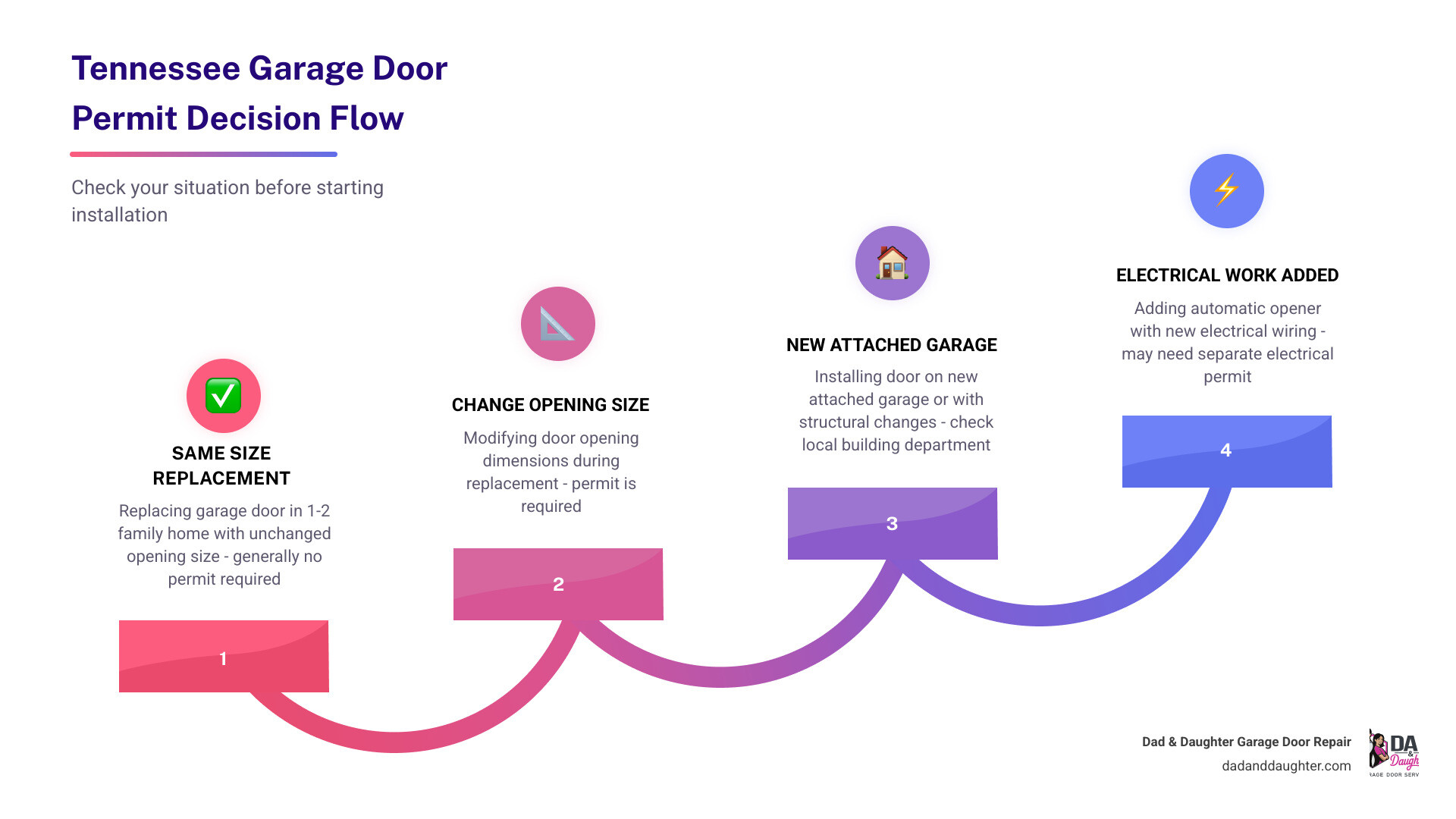
| Replacing a garage door (same opening size) in a 1-2 family home | Generally no |
| Door opening size changes during replacement | Yes |
| New garage door installation on an attached garage | Likely yes (check locally) |
| New detached garage construction | Depends on city — often yes |
| Adding an automatic opener with new electrical work | Possibly yes (electrical permit) |
Tennessee doesn’t have a single statewide answer. The state’s residential building code actually exempts detached garages from state-level permit requirements — but most incorporated cities like Nashville, Memphis, and Knoxville have their own local rules that do require permits.
In short: if you’re doing a simple like-for-like garage door swap on your home without changing the opening, you likely don’t need a permit. But once structural changes, new construction, or electrical work enter the picture, you need to check with your local building department.
Keep reading to understand exactly how Tennessee’s layered permit system works — and what to do before your next garage door project.
Do You Need a Permit to Install a Garage Door in Tennessee?
When looking at your home improvement to-do list, it is easy to assume that any work done inside or on your garage falls under “basic maintenance.” However, because garage doors are large, heavy, and under immense spring tension, they are highly regulated structural elements.
To determine if you need a permit to install a garage door in Tennessee, we first look at the scope of your project. If you are performing a standard, one-for-one replacement of an old overhead door with a brand-new one of the exact same size, a building permit is generally not required for one- and two-family dwellings. This is because the structural framing of your home remains completely untouched.

However, if your project involves changing the size of the door opening—such as converting two single garage doors into one double door, raising the header to accommodate a taller vehicle, or widening the opening—you are making structural changes to your home. In these cases, a building permit is absolutely mandatory. Altering the structural header above a garage door affects how the weight of your roof and upper floors is distributed. Without a permit and subsequent inspection, you risk structural failure.
For homeowners planning a brand-new garage construction project, a permit is always required. Whether you need a team to manage a fresh build or are planning a high-quality upgrade to your existing home, our team specializing in Garage Door Installation Nashville Area can help you navigate local codes safely.
Tennessee State Building Code vs. Local City Rules
Tennessee has a fascinating and sometimes confusing way of managing building codes. At the state level, Tennessee has adopted the 2018 International Residential Code (IRC) and the 2018 International Energy Conservation Code (IECC) as its baseline standards.
However, the state permits local cities and counties to opt out of these state building codes entirely by a two-thirds legislative vote, which must be renewed every 180 days. This means that while some rural counties in Tennessee have virtually no local building permit requirements outside of electrical and plumbing codes, incorporated cities and developed counties enforce highly detailed, localized rules.
Furthermore, major metropolitan areas often adopt newer codes faster than the state. For example, Nashville adopted the 2024 International Codes in mid-2025, making its local standards some of the most modern in the state.
To help you visualize where you stand, here is how state-level rules compare with municipal triggers:
| Standard / Location | Detached Garage Permit Exemption | Attached Garage Permit Trigger | High-Wind or Seismic Requirements |
|---|---|---|---|
| Tennessee State Code (Baseline) | Exempt if not used for living purposes | Required for any structural modifications | Standard IRC wind-load baselines |
| Incorporated Municipalities | Usually required if structure exceeds 100–120 sq. ft. | Required for new installations, structural alterations, or conversions | Varies (e.g., seismic rules in West TN, wind loads in East TN) |
When Do You Need a Permit to Install a Garage Door in Tennessee for Attached Garages?
Attached garages are treated with a much higher level of scrutiny than detached structures. Because an attached garage shares a wall (and often a roofline) with your primary living space, it represents a significant fire hazard. Cars contain fuel, oil, and electrical systems that can ignite, meaning your garage door and the surrounding walls must act as a barrier to protect your family.
Under the adopted building codes in Tennessee, attached garages require strict fire separation. The wall separating the garage from the residence must be covered with at least 1/2-inch gypsum board (drywall) on the garage side. If there are habitable living spaces built above the garage, the ceiling must be covered with 5/8-inch Type X gypsum board to slow down the spread of potential fires.
Additionally, any door leading from the attached garage into the home cannot open directly into a bedroom. This door must be either a solid wood door at least 1-3/8 inches thick, a solid or honeycomb-core steel door not less than 1-3/8 inches thick, or a 20-minute fire-rated door. It must also be equipped with a self-closing device. While replacing a garage door itself on an attached garage may not always trigger a permit, any work that alters the fire barrier or structural connection between the garage and the home will require official permitting and inspection.
Do You Need a Permit to Install a Garage Door in Tennessee for Detached Garages?
If your garage stands completely separate from your home, the rules shift. The Tennessee state residential building code specifically exempts detached garages, sheds, barns, and other accessory structures from state-level permit requirements, provided they are not used for living purposes.
However, this state-level exemption only applies in areas where the state building code is the sole enforcing authority—typically unincorporated rural areas. If you live within the city limits of any major town or within a strictly regulated county, local zoning laws and accessory structure ordinances supersede this state exemption. Most municipal codes state that any accessory structure over a certain square footage (typically 100 to 120 square feet) requires a building permit, regardless of whether it is attached or detached.
How Local Tennessee Cities Handle Garage Door Permits
Because local municipalities hold the ultimate authority over building codes in Tennessee, rules vary wildly depending on your exact address. Additionally, if you live in a neighborhood governed by a Homeowners Association (HOA), you must comply with their private covenants, which are often far more restrictive than city codes regarding the style, color, and material of your garage door.
Before starting any project, it is essential to check with your local building department. We proudly serve a wide range of communities across Middle Tennessee, East Tennessee, and Southeast Tennessee. You can find detailed regional details on our Service Areas Nashville Area page.
Nashville and Davidson County Rules
In Nashville and Davidson County, the Metro Department of Codes & Building Safety strictly regulates all construction. If you are building a new detached garage or adding onto an existing one, you must obtain a residential building permit.
In Nashville, detached accessory structures (including garages) are exempt from permits only if they are 120 square feet or less. Since almost any functional garage is larger than 120 square feet, you will need a permit. Furthermore, Nashville enforces strict zoning rules:
- Detached garages on lots smaller than 40,000 square feet are limited to one story or 16 feet in height.
- Garages with doors opening directly onto a public alley must maintain a minimum 10-foot rear setback to ensure safe vehicle maneuvering.
- Standard permit reviews in Nashville typically take 10 to 15 business days.
If you are simply replacing an existing door in Nashville and the opening size remains unchanged, you do not need a permit. However, if you run into structural alignment issues or need professional guidance, our experts in Garage Door Repair Nashville Area can ensure your door is safely aligned and meets all local safety protocols.
Memphis and Shelby County Requirements
Note: While our primary service hubs focus on Middle Tennessee, Knoxville, and Chattanooga, we want to provide a complete picture of the state’s regulatory landscape.
In Shelby County, the local building codes incorporate unique structural requirements due to the region’s proximity to the New Madrid Seismic Zone. Because of this earthquake risk, Shelby County requires seismic compliance for all new construction and additions over 400 square feet.
Additionally, Shelby County has a strict policy regarding unpermitted work: they will double the permit fees for any construction that begins before a permit is officially issued.
Knoxville and Knox County Regulations
In East Tennessee, Knoxville and Knox County maintain their own distinct building departments. If you live within the city limits of Knoxville, building permits are required for any size garage construction, and the city conducts multiple scheduled inspections throughout the build process to verify foundation, framing, and final safety compliance.
In unincorporated Knox County, permits are required for detached garages and accessory structures exceeding 120 square feet. Knoxville permit reviews are generally efficient, averaging 5 to 10 business days, but they require strict adherence to local setback rules and frost-line depths (which range from 12 to 18 inches in East and Middle Tennessee to protect foundations from freezing).
Frequently Asked Questions About Tennessee Garage Door Permits
Navigating local codes can feel like trying to read a blueprint in the dark. To help clear things up, we have compiled the most common questions we hear from homeowners across our service areas. If you have more questions, visit our Frequently Asked Questions Nashville Area resource page.
When is a permit not required for garage door installation in Tennessee?
A permit is generally not required in Tennessee if you meet all of the following criteria:
- One-for-One Replacement: You are removing an old garage door and installing a new one of the exact same dimensions.
- No Structural Alterations: You are not widening, raising, or structurally altering the door opening or the supporting header.
- No New Electrical Circuits: You are plugging your automatic opener into an existing, code-compliant GFCI outlet without running new electrical wiring behind your walls.
- No Change in Building Class: The work is being performed on a standard one- or two-family dwelling. (Commercial buildings and multi-family structures almost always require permits for door replacements).
What are the consequences of installing a garage door without a permit in Tennessee?
Skipping the permit process might seem like a timesaver, but it can backfire in several costly ways:
- Stop Work Orders: If a code enforcement officer spots unpermitted construction, they can halt your project immediately.
- Double Fees and Fines: Jurisdictions like Nashville and Shelby County charge retroactive permit fees (often double the standard rate) and daily fines until the permit is secured.
- Retroactive Inspections: You may be forced to tear down drywall or expose framing so an inspector can verify the structural work, destroying finished parts of your garage.
- Home Sale Complications: When you sell your home, the buyer’s home inspector or title company will check municipal records. If they discover an addition or a modified garage that was never permitted, it can delay or completely derail the sale.
To ensure your home remains compliant and safe, you can book a Free Estimate Nashville Area with us to discuss your project.
How do electrical requirements affect whether a permit is needed for garage door openers?
Many homeowners forget that a garage door system includes an electric motor. While mounting the physical opener to the ceiling is a mechanical task, powering it is an electrical one.
Under the National Electrical Code (NEC) adopted throughout Tennessee, all garage receptacles (outlets) must have Ground Fault Circuit Interrupter (GFCI) protection. If you already have a dedicated, GFCI-protected outlet on your garage ceiling, you can simply plug in your new opener without a permit.
However, if you do not have an outlet on the ceiling and need to run new electrical wire, install a new breaker, or add a dedicated circuit, you (or your contractor) must pull an electrical permit. In Knox County, for example, a standard electrical permit is required for new installations, and working without one can lead to project shutdowns. Always ensure a qualified professional handles any high-voltage wiring to protect your home from fire hazards.
Conclusion
Understanding whether you need a permit to install a garage door in Tennessee comes down to knowing your local municipal rules and the scope of your project. For simple, like-for-like replacements, you can usually proceed without municipal paperwork. But if you are altering your home’s structure, building a new garage, or running new electrical lines, taking the time to secure the proper permits ensures your home remains safe, legal, and structurally sound.
At Dad & Daughter Garage Door Repair, we have been serving the Nashville area and surrounding communities since 1996. As a family-owned, locally operated company without private equity backing, we pride ourselves on honest, consistent service and deep knowledge of local building codes. Whether you live in Smyrna, Franklin, Knoxville, or Chattanooga, we treat your home like our own.
Ready to upgrade your home with a beautiful, compliant garage door? Contact us today to schedule your professional Garage Door Installation Nashville Area and let our family take care of yours!
Need Help?
Contact us today to discuss your needs. Our team is ready to help.
About the Author
Dad And Daughter Garage Door Service
More Articles
View All PostsRelated Articles

Why Nashville Building Codes Dictate Specific Wind Load Ratings
An unbraced garage door is the largest structural vulnerability during severe weather. See exactly what local inspectors look for to ensure your new build meets current wind load requirements.
Read Article
The Cost Difference Between Stamped Steel and Custom Wood Doors
Choosing between custom wood and steel means looking past the initial estimate. Understand the lifetime maintenance realities of each material before your next exterior upgrade.
Read Article
Preparing Your Commercial Warehouse Doors for Winter Deliveries
September is the critical window to secure your loading docks before freezing temperatures cause mechanical failures. Learn how to address degraded hardware and protect your Q4 shipping schedule.
Read ArticleReady to Get Started?
Whether you need a repair, maintenance, or a new installation, our expert team is here to help.