How to Diagnose Garage Door Spring Issues
Dad And Daughter Garage Door Service

Learn how to tell if your garage door spring needs repair or full replacement with this expert guide.
How to Diagnose Garage Door Spring Issues
Is Your Garage Door Spring Broken, Worn, or Just Needs a Tune-Up?
Knowing how to tell if your garage door spring needs repair or full replacement can save you from a dangerous situation — and a much bigger repair bill down the road.
Here’s a quick answer:
| Situation | Repair or Replace? |
|---|---|
| Spring has lost some tension but is intact | Repair (tension adjustment by a pro) |
| Visible gap or separation in coils | Full replacement required |
| Rust or surface corrosion, coils still intact | Repair + lubrication may extend life |
| Spring is broken in two | Full replacement required |
| One spring broken on a two-spring system | Replace both springs simultaneously |
| Spring is near or past 7-10 years of use | Proactive full replacement recommended |
| Door feels heavy or opener is straining | Professional inspection needed immediately |
You hit the button, the opener hums, and… nothing. Or maybe you heard a loud bang from the garage that stopped you cold. A standard residential garage door weighs between 150 and 300 pounds, and the springs do the heavy lifting — literally. Without them working properly, that door becomes a serious hazard. In fact, spring-related issues account for more than half of all garage door service calls. The good news is that most failing springs give you warning signs before they go completely.
In this guide, we’ll walk you through exactly what to look for, how to test your door safely, and when to call in a professional.
Understanding Torsion vs. Extension Springs
Before we dive into diagnostics, we need to identify what kind of springs are keeping your garage door airborne. Residential garage doors in Tennessee generally use one of two configurations: torsion springs or extension springs.
Knowing which system you have is critical because they operate under different physical principles, fail in different ways, and present distinct safety hazards. For a deep dive into how these two systems compare, check out our guide on Torsion vs Extension Garage Door Springs Knoxville TN.
Torsion Springs
Torsion springs are the modern industry standard. They are mounted horizontally on a steel shaft directly above the garage door opening. When the door closes, heavy-duty cables attached to the bottom corners of the door wind around drums, which twists the torsion springs. This twisting action stores immense torque. When you open the door, the springs unwind, releasing that stored energy to lift the door.
Because they slide onto a solid steel shaft, torsion springs generally stay put when they break. They are highly durable, distribute weight evenly, and offer a much smoother, more controlled movement.
Extension Springs
Extension springs are an older technology, though they are still common in pre-1990s homes or garages with very low headroom. These springs run horizontally along the upper tracks on both sides of the door. Instead of twisting to store torque, extension springs stretch out like massive rubber bands when the door closes.
Because they are under immense tension when stretched, extension springs can be incredibly dangerous if they snap. Without safety cables running through the center of the coils, a breaking extension spring can become a heavy metal projectile, easily shattering car windows, damaging property, or causing catastrophic injuries.
| Feature | Torsion Springs | Extension Springs |
|---|---|---|
| Mounting Location | Horizontally above the door opening | Along the horizontal tracks on the sides |
| How Energy is Stored | Twisting (torque) | Stretching (tension) |
| Average Lifespan | 10,000 to 15,000 cycles (7–12 years) | 10,000 cycles (5–7 years) |
| Safety Risk Upon Failure | Low (retained on the shaft) | High (can fly off without safety cables) |
| Operation | Smooth, balanced, and quiet | Jerky, louder, and prone to independent wear |
How to Tell If Your Garage Door Spring Needs Repair or Full Replacement
Determining how to tell if your garage door spring needs repair or full replacement comes down to understanding the physics of metal fatigue.
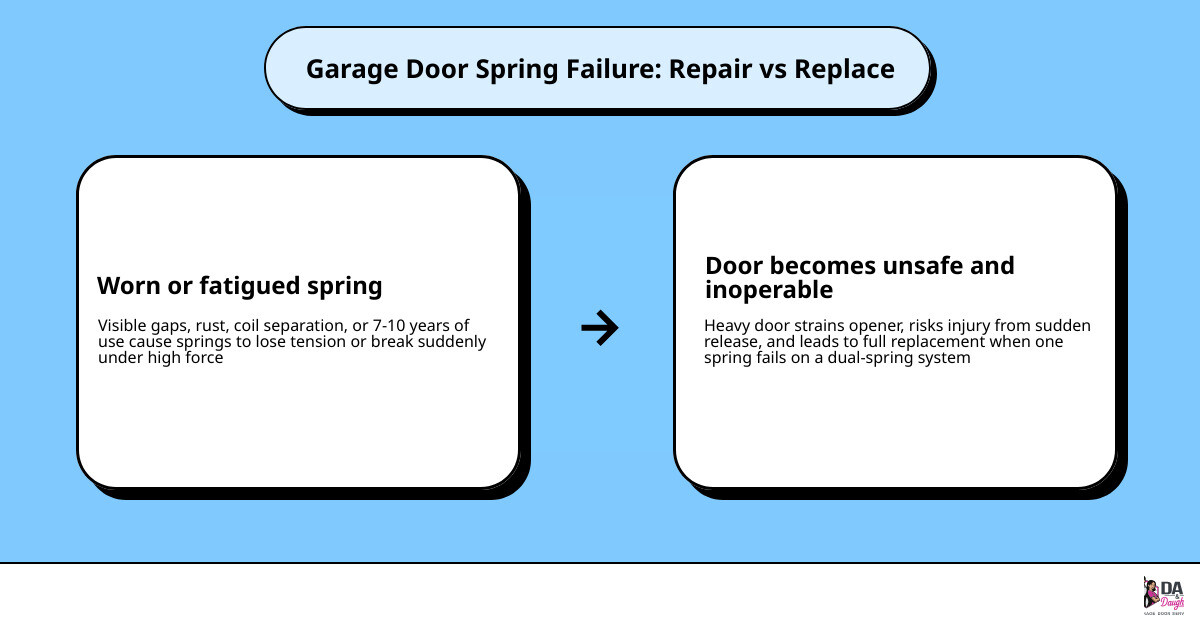
Every time your garage door opens and closes, it completes one “cycle.” Most standard builder-grade springs are rated for approximately 10,000 cycles. When a spring reaches the end of its cycle life, the steel undergoes microscopic structural changes, loses its elasticity, and eventually snaps.
If you want to spot these issues early, look at the Top Signs Garage Door Spring Needs Repair Brentwood TN to keep your household safe.
Generally, a spring that has simply lost some tension over time but is otherwise structurally sound can be “repaired” or recalibrated via a professional tension adjustment. However, if the steel is cracked, severely rusted, or physically split, repair is out of the question—you need a full replacement.

Visual Indicators: How to Tell If Your Garage Door Spring Needs Repair or Full Replacement
You can perform a visual inspection from a safe distance with the garage door fully closed. Never touch or attempt to adjust the springs during this inspection.
- Visible Gaps in the Coils: This is the most obvious sign. When a torsion spring breaks, it unwinds instantly, leaving a clear 1 to 3-inch gap in the middle of the coils. If you see a gap, your spring is completely broken and must be replaced.
- Elongated or Stretched Coils: If you have extension springs and notice that some coils look permanently stretched out or distorted even when the door is open (and the springs should be relaxed), the metal has lost its elasticity. This spring is on the verge of snapping.
- Heavy Rust and Corrosion: Surface rust can be cleaned and lubricated, but deep, pitted rust eats away at the steel’s structural integrity. Rust increases friction between the coils, accelerating metal fatigue and leading to sudden failure.
- Loose or Frayed Cables: When a spring fails or loses tension, the cables that lift the door will often slip off their drums or hang loose. If you see slack cables dangling like wet spaghetti, it is almost always a spring issue, not a cable issue.
Mechanical Tests: How to Tell If Your Garage Door Spring Needs Repair or Full Replacement
If your springs look okay visually but you suspect they are losing their strength, you can perform a couple of functional tests to evaluate their health.
The 30-Second Balance Test
A healthy garage door system should be perfectly counterbalanced. This means the springs should do 90% of the lifting, leaving the door feeling practically weightless. Here is how to test the balance:
- Close the garage door completely.
- Disconnect the automatic garage door opener by pulling the red emergency release cord.
- Manually lift the door to about waist height (mid-level position) and let go.
- Observe the door: If the door stays in place or hovers slightly, your springs are in excellent shape. If the door immediately slides down or slams shut, the springs have lost their tension and are failing to support the weight. If the door shoots upward, the springs are under too much tension (often from an improper DIY installation).
Opener Strain and Heavy Lifting
Your garage door opener is designed to guide and control the door’s movement, not lift its dead weight. Most openers are only built to handle 8 to 15 pounds of resistance.
If your springs are failing, the opener has to lift the full 150 to 300 pounds of the door. You will hear the motor straining, humming loudly, or grinding its gears. In modern openers, force-sensitivity sensors will detect this excess weight and cause the door to reverse or stop after opening only a few inches.
The Lifespan of Garage Door Springs and Why They Fail
As mentioned, standard garage door springs are rated for roughly 10,000 cycles. For a typical family that opens and closes the door 3 to 4 times a day, this translates to about 7 to 10 years of use. If your garage acts as the main entry point for your home with heavy daily traffic, you might hit that 10,000-cycle limit in as little as 4 to 5 years.
If you are tired of replacing springs every few years, you can upgrade to high-cycle springs. These heavy-duty springs are rated for 25,000 to 50,000 cycles. While they require a slightly larger upfront investment, they last significantly longer, making them an excellent choice for busy households.
Several environmental and maintenance factors can shorten a spring’s lifespan:
- Extreme Temperature Swings: Here in Tennessee, we get hot, humid summers and freezing winter nights. Rapid temperature fluctuations cause steel to expand and contract, which accelerates metal fatigue.
- Winter Weather: Cold weather makes steel more brittle. This is why springs are notorious for snapping on the coldest mornings of the year, often on the very first lift of the day.
- Lack of Lubrication: Springs need regular maintenance to perform their best. Without proper lubrication, the coils rub against each other, creating friction, heat, and rust. To protect your investment, read about how Regular Service Garage Door Springs Extends Lifespan Brentwood TN.
Immediate Safety Steps and Why DIY Is Dangerous
If you walk into your garage and realize your spring is broken, your priority must be safety.
First, do not attempt to open the door with your automatic opener. Doing so can easily burn out the motor, strip the drive gears, or bend the door panels, turning a straightforward spring replacement into a much more expensive repair.
Second, do not pull the emergency release cord while the door is open. If the door is stuck halfway up and you pull that cord, there is nothing holding the 200-pound door in place. It will crash down like a guillotine, damaging your tracks, destroying the door, or severely injuring anyone standing underneath.
We cannot emphasize this enough: DIY garage door spring replacement is incredibly dangerous.
These springs store enough energy to lift a 300-pound steel door. If that tension is released uncontrollably, it can cause severe injuries. In fact, finger and head injuries make up nearly 50% of all reported garage door accidents.
Replacing a torsion spring requires specialized winding bars, heavy-duty clamps, and precise technical knowledge. Using makeshift tools like screwdrivers or pipe wrenches to wind a spring is a recipe for disaster—one slip can send the metal bar spinning with enough force to break bones or cause life-threatening head trauma.
When your springs fail, save yourself the stress and risk by calling a professional. Learn more about staying safe by reading When the Springs Break So Should Stress with Nashville TN Garage Door Service.
Why You Should Replace Both Springs Simultaneously
If your garage door uses a two-spring system and only one of them has snapped, you might be tempted to save a bit of money by only replacing the broken one. However, this is a mistake that will cost you more in the long run.
Think of your garage door springs like a pair of running shoes. If you run 500 miles in a pair of shoes and one sole splits, you wouldn’t just buy one new shoe. The old shoe would have no support, causing you to run unevenly and hurt your knees.
The same logic applies to your garage door:
- Matched Wear and Tear: Both of your springs were installed at the exact same time. They have completed the exact same number of cycles and experienced the identical amount of metal fatigue. If one spring has snapped, the other one is living on borrowed time and will likely break within a few weeks or months.
- Balanced Tension: A brand-new spring has maximum lifting power, while an old spring has relaxed and lost some of its strength. If you mix a new spring with an old one, the door will lift unevenly. This unbalanced tension will twist the door frame, bind the rollers in the tracks, and put uneven wear on your opener.
- Saved Service Fees: By replacing both springs at the same time, you only have to pay for a technician to come out once. You’ll avoid a second service call and another round of downtime just a few months later.
To understand why proactive care is so important, read our guide on the Importance Servicing Garage Door Springs Before Break Franklin TN.
Frequently Asked Questions about Garage Door Springs
Can I open my garage door manually if a spring is broken?
We strongly advise against trying to open a garage door with a broken spring. Without the counterbalance of the spring, you are lifting the dead weight of the door, which can easily weigh 150 to 300 pounds. Attempting to lift this yourself can cause severe back strain or muscle tears. Furthermore, if you lose your grip, the door will crash down, damaging the door panels, tracks, and anything (or anyone) in its path.
Why do garage door springs break more often in cold weather?
Steel becomes significantly more brittle when exposed to freezing temperatures. When the metal is cold, it cannot handle the stress of stretching or twisting as easily as it can in warm weather. If your springs are already worn out and nearing the end of their lifespan, the added stress of a freezing winter morning is often the final straw that causes them to snap.
How often should I lubricate my garage door springs to prevent wear?
You should lubricate your garage door springs every 3 to 6 months. Use a high-quality, silicone-based spray or white lithium grease. Avoid using WD-40, as it is a degreaser rather than a long-lasting lubricant; it will quickly evaporate and leave the metal unprotected. Regular lubrication reduces friction between the coils, prevents rust from forming, and helps your springs operate quietly and smoothly.
Conclusion
Your garage door springs are the unsung heroes of your home, silently doing the heavy lifting day after day. Knowing how to tell if your garage door spring needs repair or full replacement is the key to keeping your home safe, secure, and running smoothly.
If you’ve noticed a visible gap, heard a loud bang, or felt your opener struggling, don’t wait for a total system failure.
At Dad & Daughter Garage Door Repair, we have been serving the Nashville area since 1996. As a family-owned and locally operated business with no private equity backing, we believe in honest, reliable service that treats you like family. Whether you are in Smyrna, Franklin, Brentwood, Hendersonville, or Nashville, our experienced team is ready to help.
Don’t risk the dangers of a DIY repair. Schedule professional service with Dad & Daughter Garage Door Repair today, and let us get your door back on track safely!
Need Help?
Contact us today to discuss your needs. Our team is ready to help.
About the Author
Dad And Daughter Garage Door Service
More Articles
View All PostsRelated Articles

Upgrading Weatherstripping Before the First Frost
Summer heat bakes garage door rubber, making it vulnerable to freezing directly to your driveway. Catching these cracked seals in September protects your opener motor from sudden mechanical failure.
Read Article
The Importance of Professional Track Alignment After an Impact
Accidentally bumped your garage track with the car? Pounding the metal straight might look like a quick fix, but microscopic bends will silently shred your rollers and burn out the motor.
Read Article
Troubleshooting a Blinking Light on Your Garage Door Opener
That repetitive flashing overhead isn't a glitch—it's a diagnostic code. Decode your opener's LED signals to see if you can clear a blocked sensor or if you need professional repair.
Read ArticleReady to Get Started?
Whether you need a repair, maintenance, or a new installation, our expert team is here to help.