How to Diagnose Intermittent Garage Door Opener Problems
Dad And Daughter Garage Door Service

Fix garage door opener works sometimes and not others what is wrong with this step-by-step troubleshooting guide.
How to Diagnose Intermittent Garage Door Opener Problems
Why Your Garage Door Opener Works Sometimes and Not Others — and What It Means
If your garage door opener works sometimes and not others, you’re dealing with one of the most common — and most frustrating — home maintenance problems. The good news? It almost always comes down to one of a handful of causes.
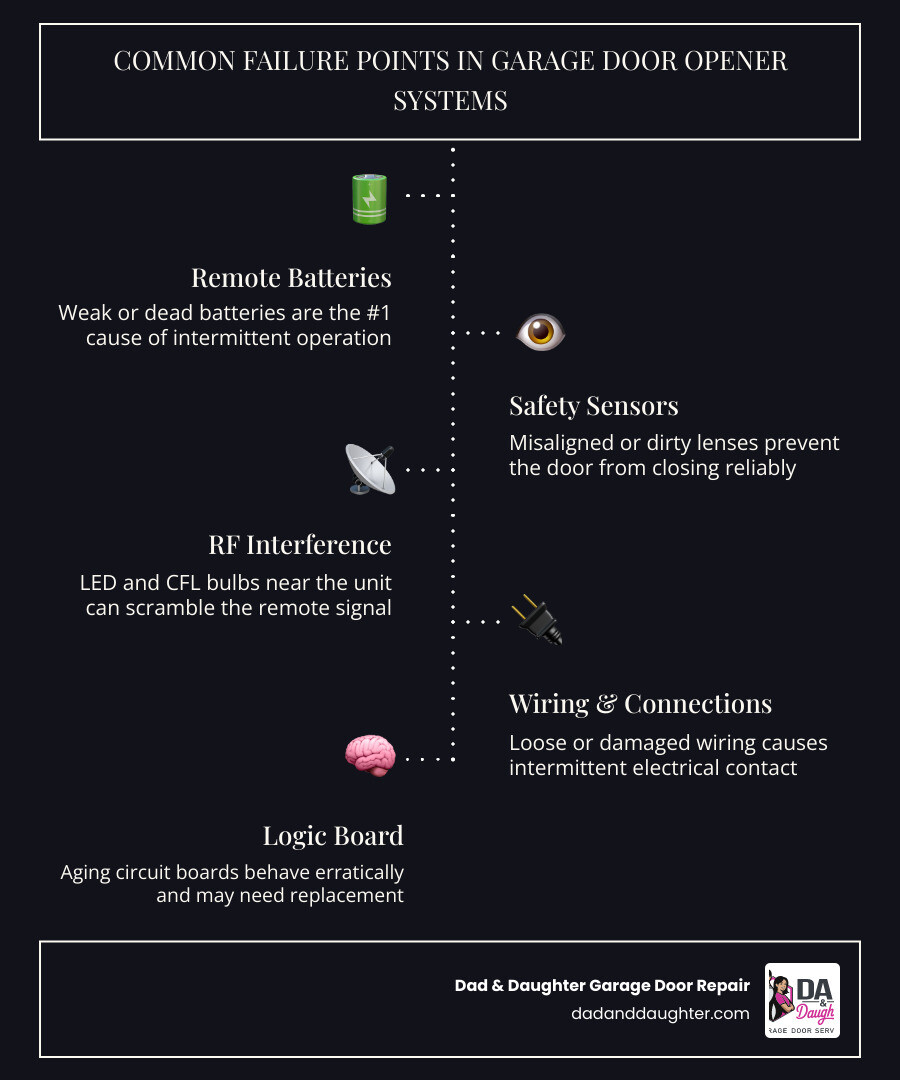
Here are the most likely reasons your garage door opener is acting up:
- Weak or dead remote batteries — the single most common cause of intermittent operation
- Safety sensor misalignment or dirty lenses — causes the door to refuse to close or reverse unexpectedly
- RF signal interference — from LED or CFL bulbs near the opener disrupting the remote signal
- Loose or damaged wiring — intermittent electrical connections inside the unit or at the wall button
- Failing logic board — the opener’s “brain” begins to behave erratically as it ages
- Accidental lock mode — the wall button’s lock feature is engaged without the homeowner realizing it
- Temperature and weather effects — cold drains alkaline batteries and stiffens mechanical components
Most of these issues are diagnosable in under 10 minutes, and several can be fixed for free or with a couple of dollars in new batteries. The sections below walk you through each one, step by step.
Garage doors are the most-used entry point in most homes, and an opener that only works sometimes is more than an annoyance — it can be a real security and safety concern. One real-world example that comes up again and again: homeowners who spend years puzzling over an intermittent remote, only to discover the culprit was a single CFL or LED bulb emitting radio frequency interference that scrambled the signal. Change the bulb, problem solved.
The causes range from the trivially simple (dead batteries) to the more serious (a failing circuit board or corroded wiring). Knowing which category you’re dealing with saves time, money, and the headache of an unnecessary service call — or, on the flip side, keeps you from ignoring a problem that’s quietly getting worse.
Garage Door Opener Works Sometimes and Not Others What Is Wrong

When your garage door opener works sometimes and not others, it often feels like your opener has developed a moody personality. One minute it operates flawlessly from down the street, and the next, you are standing inches from the door, repeatedly pressing the remote button with no response.
To understand what is going wrong, it helps to understand the relationship between the remote, the receiver, and the mechanical drive. The system relies on a clean radio frequency (RF) signal, stable household electricity, and a completely unobstructed mechanical path. If any of these elements are compromised—even temporarily—you will experience intermittent failures.
When homeowners in Middle Tennessee encounter this, they often jump to the conclusion that they need a brand-new system. However, a systematic approach to troubleshooting usually reveals a much simpler culprit. If you are in Davidson County, starting with a comprehensive inspection is always the best first step. For professional diagnostic help, scheduling a visit for Garage Door Repair Nashville Area can quickly pinpoint whether the issue is electronic or mechanical.
Remote Signal Interference: Garage Door Opener Works Sometimes and Not Others What Is Wrong
The radio signal that travels from your hand-held remote to the receiver antenna hanging from the motor unit is incredibly sensitive. If your garage door opener works sometimes and not others, signal interference is one of the most common, yet frequently overlooked, reasons.
A major source of RF interference in modern garages is the humble light bulb. Standard compact fluorescent (CFL) bulbs and many brands of LED bulbs emit electromagnetic noise when they are turned on. If you have these bulbs installed directly inside the opener unit or in nearby ceiling fixtures, they can completely block the remote’s signal. This explains why the door might open perfectly when you leave in the morning (when the lights have been off), but refuses to close when you return at night and the opener’s light has been activated.
To test for range and interference issues:
- The Range Test: Stand directly under the opener motor and press the remote. If it works consistently up close but fails from the driveway, you have a signal strength or interference issue.
- The Bulb Test: Temporarily remove the light bulbs from the opener unit and any nearby ceiling fixtures. Test the remote from the driveway. If the remote suddenly works consistently, replace those bulbs with specialized, shielded garage-door-rated LED bulbs.
- Inspect the Antenna: Ensure the small wire antenna hanging from the motor unit is not bent upward, cut, or buried inside the motor casing. It should hang straight down to maximize reception.
If you are trying to resolve signal issues in Sumner County, reviewing localized tips like our Garage Door Service Tips Hendersonville TN can provide excellent guidance on optimizing your remote’s range and avoiding common local signal blockages.
Logic Board and Wiring Faults: Garage Door Opener Works Sometimes and Not Others What Is Wrong
If the remote signal is strong but the performance remains erratic, the issue may lie deep within the opener’s electrical system. The logic board acts as the central brain of your garage door opener. Over time, power surges, lightning strikes, and simple age can degrade the solder joints and microchips on this circuit board, leading to random, intermittent operational glitches.
Additionally, loose or damaged wiring can cause the system to drop connections. The vibrations caused by the garage door opening and closing hundreds of times a year can slowly back screws out of terminal strips or rub wire insulation raw against metal brackets.
Common electrical failure signs include:
- The wall button works consistently, but remotes only work sporadically (suggesting a failing receiver on the logic board).
- The light on the wall button flickers, goes out, or changes color randomly.
- The opener loses its programmed memory overnight, requiring you to reprogram your remotes repeatedly.
When dealing with a suspected circuit board issue, homeowners face a choice between swapping out the board or replacing the entire motor head. To make an informed decision on how to handle electrical failures in Davidson County, check out our guide on whether to Repair vs Replace Garage Door Motor Nashville TN.
Step-by-Step DIY Troubleshooting Guide
Before calling out a professional technician, there are several straightforward DIY steps you can take to isolate and potentially resolve the issue. By following a logical checklist, you can eliminate the most common “free fixes” first.
| Symptom | Likely Cause | DIY Fix | Professional Repair |
|---|---|---|---|
| Works up close, not from car | Weak battery / RF interference | Replace battery / Swap LED bulbs | N/A |
| Starts to close, then reverses | Misaligned or dirty safety sensors | Clean lenses / Realign brackets | Replace faulty sensor wiring |
| Motor runs, but door doesn’t move | Disengaged trolley / Stripped gear | Re-engage manual release / Inspect gear | Replace drive gear assembly |
| Wall button works, remote does not | Lock mode engaged / Lost programming | Toggle wall lock button / Reprogram | Replace logic board |
| Completely dead intermittently | Tripped GFCI / Loose power plug | Reset outlet / Secure power cord | Repair home electrical circuit |
Checking the Safety Sensors and Tracks
Since 1993, federal law has mandated that all residential garage door openers feature photoelectric safety sensors. These sensors project an invisible infrared beam across the bottom of the door opening. If that beam is broken, the door will not close.
If your door opens fine but only closes sometimes—or starts to close and then pops back up—your safety sensors are likely the cause.
- Check the LED Indicators: One sensor (the sending eye) should have a solid green light, while the other (the receiving eye) should have a solid amber or red light. If either light is blinking, flickering, or completely dark, the sensors are out of alignment.
- Clean the Lenses: Dust, dirt, cobwebs, and moisture can accumulate on the glass lenses, blocking the infrared light. Wipe them down gently with a clean microfiber cloth.
- Inspect the Track and Path: Ensure there are no trash cans, tools, or toys breaking the beam. Also, check the tracks for physical obstructions, dirt buildup, or bent sections that might mimic an obstruction by causing a sudden spike in mechanical resistance.
When a door encounters resistance due to track issues, it can easily jump out of its tracks entirely, which is a major safety hazard. To recognize these early warning signs, read our article on Garage Door Off Track Warning Signs Nashville TN.
Performing a Power Reset and Reprogramming
Just like your home computer or Wi-Fi router, a garage door opener can benefit from a hard power reset to clear temporary system glitches and memory errors.
- Unplug the Opener: Locate the power outlet on your garage ceiling and unplug the motor unit. Leave it unplugged for a full 60 seconds to allow the internal capacitors on the logic board to drain completely.
- Plug It Back In: Restore power. You should hear a click or see the overhead lights flash, indicating the system has rebooted.
- Clear and Reprogram the Remotes: If the remote signal remains inconsistent, locate the “Learn” button on the back of the motor unit. Press and hold it for approximately 6 to 10 seconds until the indicator light goes out. This erases all programmed remotes and keypads, clearing out any corrupted signal codes.
- Re-pair Your Devices: Press the Learn button briefly (do not hold it), then press the button on your hand-held remote. The opener lights should flash to confirm successful programming.
If you are curious about how professional technicians systematically evaluate these issues during a service visit, you can read about our process in How Does Our Three-Step Plan for Garage Door Service in Nashville Work?.
Environmental and Mechanical Factors Affecting Performance
Often, a garage door opener works perfectly during the warm afternoon but fails completely during a freezing winter morning or a humid summer rainstorm. Environmental and mechanical factors play a massive role in how consistently your door operates.
Temperature and Weather Impacts
Extreme temperature swings can wreak havoc on both the electronic and mechanical components of your garage door system:
- Battery Drainage: Cold weather significantly reduces the voltage of alkaline batteries inside your remotes and exterior wireless keypads. A cold battery might not have enough power to send a strong signal in the morning, but as the temperature warms up during the day, the battery recovers enough voltage to work again. Switching to lithium batteries can resolve this, as they perform much better in freezing temperatures.
- Metal Contraction and Friction: Cold weather causes the metal tracks, rollers, and hinges to contract. This contraction, combined with old grease that thickens and hardens in the cold, creates immense mechanical resistance. If the motor has to push too hard to move the door, the safety force limits will trigger, causing the door to stop mid-cycle or reverse.
- Moisture and Corrosion: High humidity and rain can cause electrical shorts in exposed wiring or accelerate corrosion on the safety sensor wire connections.
Regular preventative care is crucial to keeping your door running smoothly through every Tennessee season. For homeowners in Rutherford County, we highly recommend checking out our guide on Garage Door Service Maintenance Thompsons Station TN to keep your system prepared for weather extremes.
Mechanical Wear and Cable Issues
Your garage door opener does not actually do the heavy lifting of raising your door; that is the job of the torsion or extension springs. The opener simply acts as the guide and initiator of the movement.
If your springs are weakening, or if your lift cables are frayed and slipping, the door will become incredibly heavy and unbalanced. An unbalanced door places extreme stress on the opener motor. The motor may manage to lift the door occasionally, but on other attempts, it will overheat, stall, or reverse due to the excessive physical strain.
- The Balance Test: Pull the red emergency release cord to disconnect the door from the opener. Manually lift the door halfway. It should stay in place. If it slams shut or shoots upward, your springs are out of balance.
- Inspect the Cables: Look closely at the steel cables on both sides of the door. If you see loose strands, rust, or cables that have slipped off their drums, do not attempt to operate the door.
Operating a door with compromised cables can lead to catastrophic failure. Learn more about maintaining these critical components by reading Garage Door Cables Need Regular Service Functional Nashville TN.
When to Stop DIY and Call a Professional
While replacing remote batteries, cleaning safety sensors, and clearing tracks are perfectly safe DIY tasks, there is a clear line where self-repair becomes dangerous.
You should immediately stop troubleshooting and call a professional if:
- The Torsion Springs Are Broken or Damaged: Garage door springs are kept under extreme, life-threatening tension. Attempting to adjust, repair, or replace springs without specialized training and tools can result in severe injury or death.
- The Cables Are Frayed or Off the Drum: Like springs, cables are under high tension and require professional handling.
- The Door is Visually Crooked or Off-Track: Trying to force a crooked door to move can permanently damage the door panels, tracks, and the opener itself.
- The Opener Motor Emits a Burning Smell or Smoke: This indicates a serious electrical short or a completely burned-out motor windings, which is a fire hazard.
- The Logic Board Needs Replacement: While some homeowners feel comfortable swapping boards, a professional technician can ensure the new board is properly calibrated, safety limits are programmed correctly, and the warranty remains intact.
If you are experiencing any of these severe symptoms in the Nashville area, do not risk your safety. Reach out to our experienced local team for safe, reliable Garage Door Repair Nashville TN.
Frequently Asked Questions about Intermittent Garage Doors
Can LED light bulbs cause my garage door remote to work intermittently?
Yes, absolutely. Many standard LED and CFL light bulbs emit radio frequency interference (RFI) that operates on the exact same frequency band (typically 315 MHz or 390 MHz) as your garage door remote. When the light bulb is illuminated, it creates an electromagnetic “noise” that drowns out the signal from your remote. To resolve this, always use specialized, shielded LED bulbs labeled as “garage door compatible.”
How long do garage door openers typically last?
On average, a residential garage door opener lasts between 10 to 15 years. If your opener is approaching or has passed the decade mark and has started operating intermittently, it is likely experiencing normal wear and tear on its internal gears, motor capacitor, or logic board. At this stage, components begin to degrade, and replacing the unit is often more cost-effective than continuous repairs.
What is the $200 rule for repairing vs replacing an opener?
The $200 rule is a simple financial guideline for homeowners. If your garage door opener is over 10 years old, and the cost of a professional repair (parts and labor) is quoted at $200 or more, it is generally wiser to invest that money toward a brand-new, modern opener. A new opener will come with a fresh manufacturer warranty, updated security features (like rolling codes), and modern conveniences like built-in Wi-Fi connectivity.
Conclusion
An intermittent garage door opener is a major disruption to your daily routine, but in most cases, the solution is just a few troubleshooting steps away. By systematically checking your remote batteries, eliminating light bulb interference, cleaning your safety sensors, and inspecting your tracks for debris, you can resolve the majority of “moody” opener issues on your own.
When the problem requires professional diagnostics, mechanical adjustments, or a full system replacement, Dad & Daughter Garage Door Repair is here to help. We are a family-owned, locally operated garage door company serving the Nashville area since 1996. Because we operate without private equity backing, we focus strictly on honest, high-quality customer care and consistent service across all our local communities—from Franklin and Brentwood to Murfreesboro and beyond.
If you are tired of guessing whether your garage door will open today, contact us to schedule a professional diagnostic visit or request a free estimate. Let our family take care of yours by visiting our Garage Door Repair Nashville Area page today!
Need Help?
Contact us today to discuss your needs. Our team is ready to help.
About the Author
Dad And Daughter Garage Door Service
More Articles
View All PostsRelated Articles

Why Nashville Building Codes Dictate Specific Wind Load Ratings
An unbraced garage door is the largest structural vulnerability during severe weather. See exactly what local inspectors look for to ensure your new build meets current wind load requirements.
Read Article
The Cost Difference Between Stamped Steel and Custom Wood Doors
Choosing between custom wood and steel means looking past the initial estimate. Understand the lifetime maintenance realities of each material before your next exterior upgrade.
Read Article
Preparing Your Commercial Warehouse Doors for Winter Deliveries
September is the critical window to secure your loading docks before freezing temperatures cause mechanical failures. Learn how to address degraded hardware and protect your Q4 shipping schedule.
Read ArticleReady to Get Started?
Whether you need a repair, maintenance, or a new installation, our expert team is here to help.