How to Fix Garage Door That Opens on Its Own
Dad And Daughter Garage Door Service

Discover what causes garage door opens on its own what causes this and fix phantom openings fast with our troubleshooting guide.
How to Fix Garage Door That Opens on Its Own
Why Your Garage Door Opens on Its Own — and What to Do About It
If you’ve ever walked into your garage to find the door wide open when you’re sure you closed it, you already know how unsettling it can be. garage door opens on its own what causes this? The short answer: it’s almost always one of a handful of fixable problems, not a mystery.
Here are the most common causes at a glance:
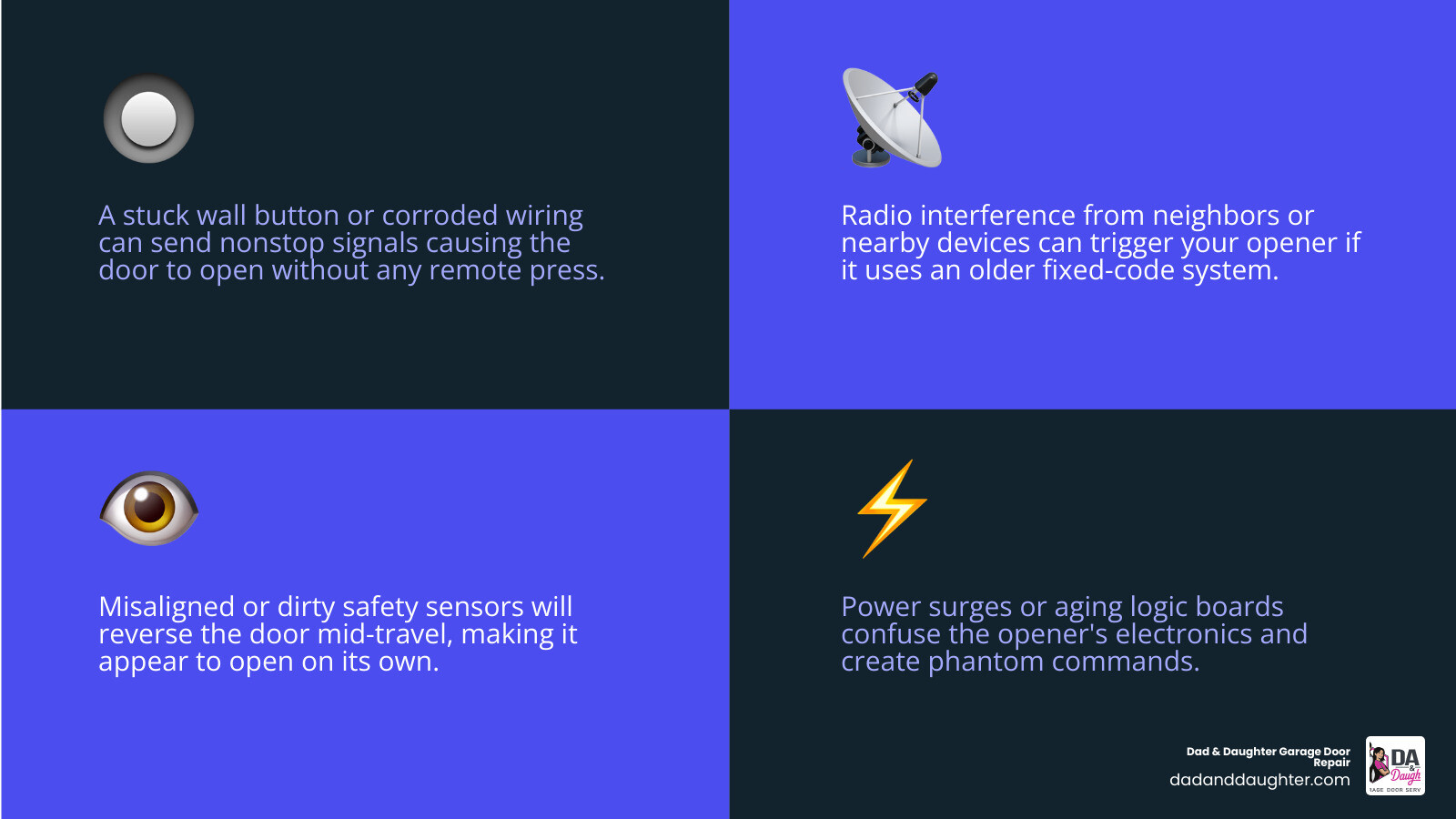
- Stuck or shorted wall button — a worn or dirty button that sends a continuous signal
- Remote control issues — dead batteries sending erratic signals, or a button jammed in the pressed position
- Radio frequency interference — nearby devices or a neighbor’s older opener triggering yours
- Power surge or lightning strike — electrical spikes that confuse the opener’s logic board
- Misaligned or dirty safety sensors — the door reverses mid-close and appears to reopen on its own
- Incorrect travel limit settings — the opener thinks the door hasn’t fully closed and drives it back up
- Wiring shorts or corrosion — damaged low-voltage wiring creating intermittent false signals
- Aging logic board — worn electronics in openers over 10–15 years old that misread commands
This isn’t just an inconvenience. An unexpectedly open garage is a real security risk — it leaves your home, vehicle, and family exposed. The good news is that most causes can be identified with a simple, methodical inspection, and many can be fixed without calling anyone.
Read on and we’ll walk you through exactly how to find the culprit and stop it for good.
Garage Door Opens on Its Own: What Causes This?
When your garage door starts acting like it has a mind of its own, it is easy to feel a little spooked. It’s like your house decided to invite the neighborhood raccoons in for a midnight snack! However, as professional technicians, we look at this through a highly systematic lens.
In our years of providing dependable Garage Door Repair Nashville Area services, we have found that phantom openings almost always fall into one of two categories: electrical/programming faults or mechanical/safety reversals.
- Electrical and Programming Faults: These are true “ghost” openings. The opener motor actually receives a command to run, even though you didn’t press a button. This is caused by shorted wires, stuck buttons, radio frequency (RF) interference, or a damaged logic board.
- Mechanical and Safety Reversals: These are “accidental” openings. You press the button to close the door, walk away, and the door reverses and opens back up because it thinks it hit an obstacle or the safety sensors lost alignment.
To help you narrow down the search, we’ve put together this quick diagnostic comparison table:
| Symptom Pattern | Most Likely Category | Common Root Causes |
|---|---|---|
| Randomly opens hours after closing (often in the middle of the night or while you are at work) | Electrical / Programming | Stuck remote button, wall console corrosion, RF interference, damaged logic board, or temperature-induced wiring shorts. |
| Opens immediately after hitting the floor (reverses instantly upon closing) | Mechanical / Limits | Incorrect travel limit settings, debris under the door, or a concrete floor that has shifted slightly over time. |
| Starts to close, then reverses halfway down | Safety Sensors / Tracks | Misaligned photo-eye sensors, loose sensor brackets, direct sunlight blinding the receiver, or binding tracks. |
| Opens immediately after a major storm | Electrical / Surge | Lightning strike power surge damaging the internal logic board circuitry. |
Remote Control and Wall Button Malfunctions
Let’s start with the simplest and most common culprits: your physical controllers. Just like a sticky television remote that randomly changes channels, your garage door remotes and wall buttons are prone to physical wear and tear.
A remote control that has been tossed into a crowded glovebox, stuffed into a purse, or dropped on the driveway can easily develop a stuck button. If the internal contact pad under the rubber button becomes wedged or dirty, it can continuously or intermittently broadcast the open signal. Even low or dying batteries can sometimes cause the transmitter to send erratic, weak signals that the opener misinterprets as a command to cycle.
The wall console inside your garage is another frequent offender. Over time, dust, moisture, and even tiny spiders can get behind the wall button, bridging the electrical contacts. If you are dealing with a sticky button, check out our Garage Door Service Tips Hendersonville TN for advice on how to safely clean and maintain these components without damaging the low-voltage system.
Radio Frequency and Signal Interference
Could a neighbor’s remote really be opening your garage door? The answer depends entirely on how old your garage door opener is.
If your opener was manufactured before 1993, it likely uses a fixed-code system configured by physical DIP switches (tiny plastic switches inside the remote and the motor unit). These older systems only had about 256 possible code combinations. In a densely populated neighborhood, there is a very real chance that a neighbor’s remote is set to the exact same frequency and code as yours.
Modern garage door openers, however, use rolling-code technology (introduced in the mid-to-late 1990s). Every single time you press your remote, a new, encrypted code is selected from billions of possible combinations. With rolling codes, it is virtually impossible for a neighbor’s remote or a tech-savvy intruder to accidentally or intentionally open your door.
However, modern systems are still susceptible to general radio frequency (RF) interference. Nearby military bases, police radios, ham radio setups, and even cheap LED lightbulbs installed inside the opener itself can emit electromagnetic interference that disrupts the receiver, occasionally causing the logic board to misread background noise as an activation command.
Electrical and Environmental Triggers for Phantom Openings
If your remotes and frequencies check out fine, the next place to look is the electrical heart of your system: the logic board and its associated wiring.

Your garage door opener is essentially a small computer paired with a powerful electric motor. Inside the motor housing sits the logic board (or circuit board). This board processes the signals from your wall button, remotes, safety sensors, and smart home modules. When something disrupts this board, the results are highly unpredictable. If you suspect your motor’s brain is failing, our guide on Garage Door Motor Repair Murfreesboro TN explains how we diagnose and resolve these complex electrical glitches.
Garage Door Opens on Its Own: What Causes This During Storms?
We frequently receive frantic calls from homeowners right after a heavy Middle Tennessee thunderstorm. Lightning strikes and power surges are notorious for wreaking havoc on residential electronics, and garage door openers are prime targets.
According to insurance and service industry data, lightning surges or logic board damage account for approximately 34% of all phantom garage door opening cases. When a power surge traveling through the home’s electrical grid hits an unprotected garage door opener, it can partially melt or damage the delicate microchips on the logic board. This damage often manifests as a “scrambled” brain, causing the opener to cycle the door completely at random.
Furthermore, extreme humidity and heavy rainfall can introduce moisture into the external wiring or the wall button housing. If you are trying to decide whether it is time to salvage your current setup or upgrade to a more resilient system, read our detailed comparison on Repair vs Replace Garage Door Motor Nashville TN.
Wiring Shorts and Corroded Wall Consoles
Low-voltage wiring connects your opener motor to the wall button and the safety sensors. This thin wire is typically stapled along the ceiling and walls of your garage. While it carries very little voltage, it is highly vulnerable to physical damage.
Common causes of wiring shorts include:
- Rodent Damage: Mice and rats love to chew on the soft plastic insulation surrounding these wires, leaving exposed copper that can touch and create a short circuit.
- Corrosion from Humidity: High humidity levels can cause the wire terminals at the wall button or the motor head to corrode, leading to intermittent connections.
- Temperature Drops: During chilly winter nights, copper wiring contracts. This slight physical movement can cause damaged or pinched wires to touch, creating a temporary short circuit that triggers a phantom opening in the middle of the night.
If you are located south of Nashville, our team can help you trace these tricky electrical bugs; check out our Garage Door Repair Solutions Thompsons Station TN to see how we handle local wiring and console overhauls.
Mechanical and Sensor Issues That Force Reversals
Sometimes, your garage door isn’t opening because of a rogue signal; instead, it is opening because its built-in safety systems are doing exactly what they were designed to do: reversing the door to prevent property damage or injury.
Federal safety regulations require all automatic garage door openers manufactured after 1993 to feature an automatic reversing mechanism. If the door encounters an obstruction or if the safety beam is broken while closing, the opener must immediately stop and reverse the door back to the fully open position. If you notice your door reversing and shaking, it could also be a sign of track issues; learn more by reading about Garage Door Off Track Warning Signs Nashville TN.
Safety Sensor Misalignment and Blockages
At the bottom of your left and right garage door tracks, about six inches off the ground, are your photo-eye safety sensors. One sensor emits an invisible infrared light beam, and the other receives it.
If this beam is broken for even a fraction of a second while the door is closing, the door will instantly reverse and open. Common issues include:
- Dirt and Debris: Cobwebs, dust, or dried mud on the sensor lenses can block the infrared beam.
- Vibration Misalignment: As the door rolls down, the vibration of the tracks can shake a loose sensor bracket out of alignment, breaking the beam mid-cycle.
- Damaged Sensor Cables: Loose or fraying sensor wires can break the circuit as the door moves. To keep your overall system running smoothly, check out our guide on why Garage Door Cables Need Regular Service Functional Nashville TN.
Travel Limits and Broken Springs
Your garage door opener has “travel limit” settings that tell the motor exactly how far to spin to fully open or close the door.
If the down-travel limit is set too high, the door will hit the concrete floor before the opener thinks it has reached its destination. The opener interprets the resistance of the concrete floor as an obstruction, triggers the safety reversal, and drives the door back up.
Additionally, if your garage door springs are worn out or broken, the door becomes incredibly heavy and unbalanced. The opener motor has to work twice as hard to move it, which can trip the internal force sensitivity limits and cause the door to reverse randomly. If you suspect your springs are losing their tension, look for the Top Signs Garage Door Spring Needs Repair Brentwood TN.
How to Troubleshoot and Prevent Unexpected Openings
If your garage door is acting up, don’t panic. You can systematically isolate and resolve the issue by following these steps:
- Perform the 24-Hour Remote Test: Remove the batteries from all of your handheld remotes and keypads and store them in a drawer. If the door stops opening on its own, you know one of your remotes has a stuck button or a failing battery.
- Isolate the Wall Console: Disconnect the wall button wires from the back of the opener motor. If the phantom openings stop, the issue is either a short in the wall button itself or a staple pinched through the bell wire.
- Clean and Align the Sensors: Wipe the photo-eye lenses with a soft microfiber cloth. Ensure that the LED lights on both sensors are glowing steadily (usually green on one side and amber on the other) without flickering.
- Install a Motor-Rated Surge Protector: Plug your opener into a dedicated single-outlet surge protector designed for electric motors to shield the logic board from future lightning strikes.
- Clear and Reprogram the Memory: Press and hold the “Learn” button on your opener motor for about 6 seconds until the indicator light goes out. This erases all remotes and wireless devices from the memory. Afterward, reprogram your remotes one by one.
For a complete checklist on keeping your entire system in top-tier shape, read our comprehensive Garage Door Service Guide Gallatin TN.
Troubleshooting a Garage Door Opens on Its Own: What Causes This in Older Models?
Older garage door openers require a slightly different approach. Because they lack modern diagnostics and rolling-code security, they are far more susceptible to external radio interference and physical component wear.
If you have an older DIP-switch model, try changing the code sequence. Simply slide the tiny switches inside the remote and the motor head to a new, identical pattern. This will instantly block any neighbors who happen to be operating on your old frequency.
Furthermore, older wiring insulation degrades over time, becoming brittle and cracking. This leads to intermittent short circuits that are highly sensitive to seasonal temperature swings. For homeowners managing older equipment, our Garage Door Service Maintenance Thompsons Station TN guide offers practical tips to extend the lifespan of aging systems safely.
Frequently Asked Questions About Phantom Garage Door Openings
Can smart home integrations or Wi-Fi devices cause my garage door to open by itself?
Yes, they can. While smart garage door openers add incredible convenience, misconfigured automations, smart home app glitches, or geofencing errors (where the app thinks you have arrived home when you are actually just driving nearby) can trigger unexpected openings. If you suspect a smart-home glitch, check your automation logs in your Apple Home, Google Home, or manufacturer app to see exactly which device sent the “open” command.
Is it safe to leave my garage door opener unplugged until I find the cause?
Absolutely. If your garage door is opening on its own and you need to secure your home immediately or go to sleep without worrying, simply unplug the opener from the ceiling outlet. To lock the door, pull the red emergency release cord to disengage the trolley, and manually slide the door down. You can then engage the physical slide lock on the side of the garage door for total security.
How long do garage door openers typically last before experiencing these issues?
Most residential garage door openers have a reliable lifespan of 10 to 15 years. As the system approaches or exceeds this range, the internal electronic components, plastic gears, and logic board circuits naturally degrade, making phantom operations and mechanical failures much more common. To learn more about what to expect as your system ages, check out our guide on Garage Door Service Expectations Spring Hill TN.
When to Call a Professional for Garage Door Repair
While cleaning your safety sensors or replacing remote batteries are easy weekend DIY projects, some garage door issues should always be left to the experts.
If your troubleshooting points to a failing logic board, damaged internal motor gears, a cracked torsion spring, or complex electrical wiring problems, attempting to fix them yourself can be incredibly dangerous. Garage door springs and cables operate under immense tension and can cause severe injury if mishandled.
If you are dealing with a stubborn “ghost” door in the Nashville area, we are here to help. Dad & Daughter Garage Door Repair is a family-owned and locally operated company. We have been serving our Tennessee neighbors since 1996 without any private equity backing. We believe in honest, high-quality workmanship, consistent service, and treating our customers like family.
Whether you need a simple sensor adjustment, a logic board replacement, or a complete system upgrade, we’ve got you covered. Contact us today through our Dad and Daughter Garage Door Repair Nashville Area page to schedule a professional, hassle-free diagnostic visit!
Need Help?
Contact us today to discuss your needs. Our team is ready to help.
About the Author
Dad And Daughter Garage Door Service
More Articles
View All PostsRelated Articles

Upgrading Weatherstripping Before the First Frost
Summer heat bakes garage door rubber, making it vulnerable to freezing directly to your driveway. Catching these cracked seals in September protects your opener motor from sudden mechanical failure.
Read Article
The Importance of Professional Track Alignment After an Impact
Accidentally bumped your garage track with the car? Pounding the metal straight might look like a quick fix, but microscopic bends will silently shred your rollers and burn out the motor.
Read Article
Troubleshooting a Blinking Light on Your Garage Door Opener
That repetitive flashing overhead isn't a glitch—it's a diagnostic code. Decode your opener's LED signals to see if you can clear a blocked sensor or if you need professional repair.
Read ArticleReady to Get Started?
Whether you need a repair, maintenance, or a new installation, our expert team is here to help.