How to Lubricate Garage Door Springs, Rollers & Hinges Correctly
Dad And Daughter Garage Door Service

Learn how to lubricate garage door springs rollers and hinges correctly with the right products and steps for smooth, quiet performance.
How to Lubricate Garage Door Springs, Rollers & Hinges Correctly
Your Garage Door Is Trying to Tell You Something
Knowing how to lubricate garage door springs, rollers, and hinges correctly can be the difference between a door that quietly glides open every morning and one that groans, grinds, and eventually breaks down at the worst possible moment. Here’s a quick answer before we dive deeper:
How to lubricate garage door springs, rollers, and hinges correctly — quick steps:
- Close the door and disconnect the opener from power before starting
- Wipe down all components with a dry cloth to remove dirt and debris
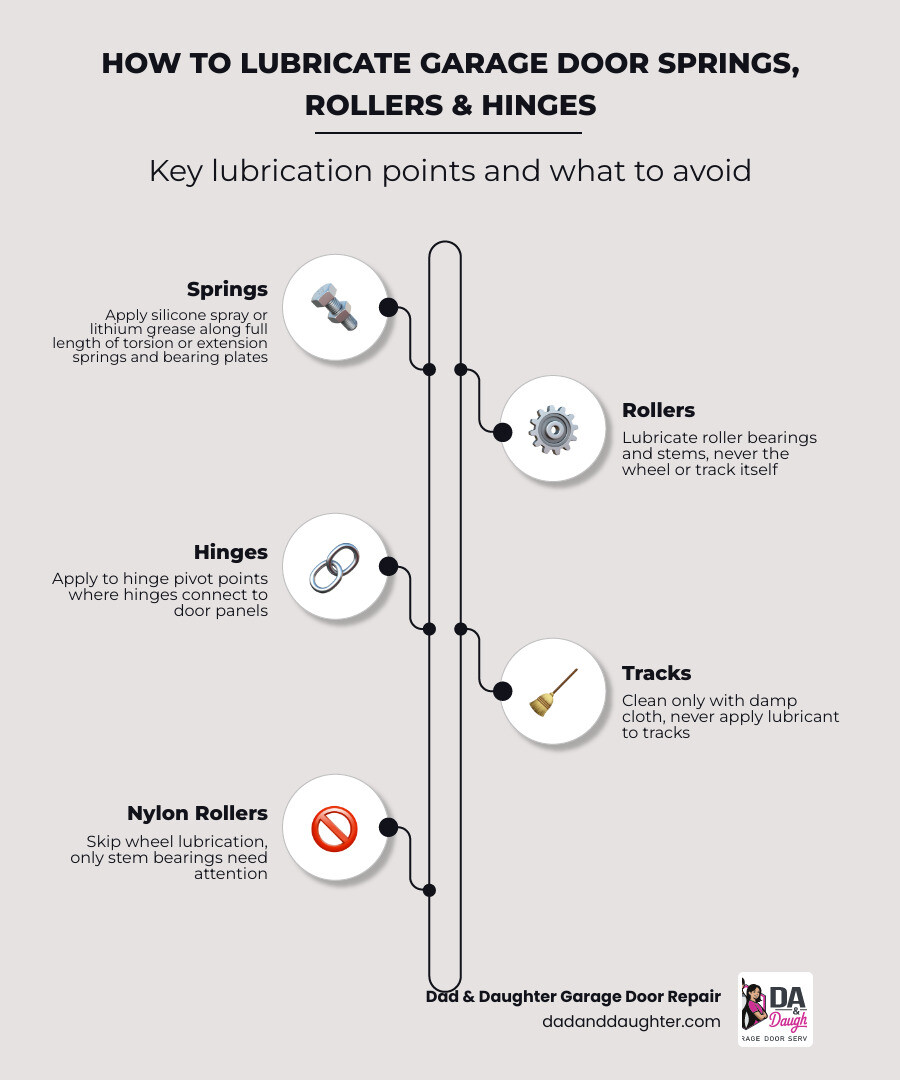
- Apply silicone spray or white lithium grease to:
- Torsion or extension springs (along the full length)
- Roller bearings (not the wheel or track)
- Hinge pivot points (where hinges connect to door panels)
- End-bearing plates on each side of the spring
- Never apply lubricant to the tracks — clean them with a damp cloth only
- Skip nylon rollers — their wheels don’t need lubrication, only the stem bearings do
- Open and close the door manually several times to work the lubricant in
- Wipe away any excess to prevent drips and dust buildup
- Repeat every 3 to 6 months, or more often in harsh climates
A noisy or sluggish garage door is more than an annoyance — it’s often an early warning sign. Garage doors are one of the largest and heaviest moving parts in your home, cycling up and down hundreds of times each year. Every time they move, metal components grind against each other, springs flex under tension, and rollers spin inside steel tracks. Without regular lubrication, that friction builds up fast. According to industry data, a well-lubricated torsion spring can last 15,000 to 20,000 cycles, while a dry or rusty one may fail in as few as 7,000. That’s a significant difference — and the fix takes about 15 minutes and costs less than a can of spray lubricant.
The problem most homeowners run into isn’t laziness — it’s grabbing the wrong product or applying it in the wrong places. A can of WD-40 sitting on the shelf feels like the obvious answer when something squeaks. But WD-40 is actually a solvent, not a lubricant. It strips away existing grease, evaporates within hours, and leaves bare metal more vulnerable than before. Getting this right matters, and it’s simpler than most people think.
Why Proper Lubrication Matters and What Products to Use
Every time you press your garage door remote, a complex mechanical dance takes place. The opener motor initiates the movement, but the heavy lifting is done by the springs, which balance the door’s weight (often upwards of 300 pounds). The rollers guide the door along the tracks, while the hinges allow the individual panels to bend smoothly as they transition from vertical to horizontal.
Without adequate lubrication, friction becomes the enemy of your entire garage door system. This friction has several costly consequences:
- Shortened Component Lifespan: Metal-on-metal grinding wears down hinge pins, eats away at roller bearings, and creates micro-fractures in high-tension springs.
- Rust and Corrosion: Humidity in Middle and East Tennessee can be brutal. Rust acts like sandpaper on moving parts and structurally weakens steel springs.
- Opener Motor Strain: When the mechanical parts don’t glide smoothly, your automatic opener has to work twice as hard to pull and push the door. This can burn out the motor gears prematurely.
To protect these hard-working parts, you need to use the right products. In our years of keeping garage doors running smoothly, we’ve seen many well-intentioned DIY attempts go wrong simply because of product choice.
When choosing a lubricant, you have two primary professional-grade options: silicone-based spray and white lithium grease.
- Silicone Spray: This is a light, fast-drying lubricant that penetrates tight spaces easily. It is highly resistant to moisture, making it excellent for humid environments. It doesn’t attract dust or grit, keeping your hardware clean over time.
- White Lithium Grease: This is a thicker, paste-like lubricant that comes in both aerosol sprays and tubes. It excels at heavy-duty, load-bearing applications because it clings to vertical metal surfaces and provides a thick cushion against high friction.
To help you decide which to use, we’ve broken down their performance characteristics below. For more tips on general upkeep, check out our Garage Maintenance Category.
Lubricant Comparison Table
| Feature | Silicone-Based Spray | White Lithium Grease | Standard WD-40 (Avoid!) |
|---|---|---|---|
| Primary Function | Lubrication & moisture barrier | Heavy-duty friction reduction | Cleaning & water displacement |
| Viscosity | Thin, fast-penetrating | Thick, clingy | Extremely thin, evaporates quickly |
| Dust Attraction | Very low | Low to moderate | High (creates sticky buildup) |
| Best Used On | Roller bearings, hinges, rubber seals | Torsion springs, heavy hinges, lock bars | Cleaning rusty parts before greasing |
| Temperature Range | Excellent (-20°F to 250°F+) | Good (holds up in extreme cold/heat) | Poor (breaks down rapidly) |
A common mistake is grabbing household oils, cooking sprays, or standard WD-40. Standard WD-40 is a degreaser and solvent. While it will temporarily stop a squeak by cleaning away rust, it actually strips away any remaining protective grease. Once it evaporates, you are left with dry, unprotected metal that will wear out much faster. Stick to high-quality, dedicated garage door lubricants.
How to Lubricate Garage Door Springs Rollers and Hinges Correctly
Before you spray a single drop of lubricant, proper preparation is key to both your safety and the effectiveness of the job.
The Pre-Lubrication Checklist:
- Close the Door Fully: Never attempt to perform maintenance or apply lubricant while the garage door is open or in motion.
- Disconnect the Power: Unplug the automatic garage door opener from the ceiling outlet. If your outlet is hard to reach, pull the red emergency release cord to manually disconnect the door from the opener carriage. This ensures no one can accidentally activate the door while your hands are near the moving parts.
- Gather Your Tools: You will need your chosen lubricants, a clean microfiber cloth, safety glasses, heavy-duty gloves, and a piece of cardboard to use as a shield against overspray.
- Clean the Hardware first: Spraying fresh lubricant over old, dirty grease just creates an abrasive grinding paste. Use a dry cloth or a brush to clear away cobwebs, dust, and old grease from the hinges, rollers, and springs. If there is stubborn grime, a mild household degreaser or brake cleaner can be used to clean the metal surfaces—just make sure they are completely dry before applying the new lubricant.
Taking these prep steps ensures that the lubricant adheres directly to the clean metal, giving you the quietest operation possible. For more hands-on advice on preparing your system, read through our Garage Door Service Tips Hendersonville TN.
How to Lubricate Garage Door Springs Rollers and Hinges Correctly: Springs
Your garage door springs are under immense tension. They balance the weight of the door, making it light enough to lift manually or with a small electric motor. Because they are constantly flexing and tightly wound, they require careful attention.
There are two main types of garage door spring systems:
- Torsion Springs: These are located on a metal shaft directly above the closed garage door opening.
- Extension Springs: These run horizontally above the upper tracks on both sides of the door.
Step-by-Step Spring Lubrication:
- Position Your Shield: Hold a piece of cardboard behind the spring to protect your garage walls or ceiling from overspray.
- Apply the Lubricant: Using either white lithium grease or a high-quality silicone spray with a straw nozzle, apply a light, even coat along the entire top length of the spring. You do not need to soak it; a thin, consistent layer is perfect.
- Let Gravity Do the Work: The lubricant will naturally seep down between the tightly wound coils of the spring, coating the inner surfaces where the metal rubs together during operation.
- Don’t Forget the Bearing Plates: On both sides of your torsion spring shaft, you will find circular metal plates called end-bearing plates. These contain ball bearings that allow the shaft to spin. Apply a quick 1-to-2-second spray directly into the center of these bearing plates. Dry end-bearings are the primary cause of loud, machine-gun-style rattling noises when the door operates.
- Wipe Away Drips: Use a clean rag to wipe up any excess lubricant dripping from the bottom of the springs to keep your garage floor clean.
Safety Note: While lubricating springs is a safe DIY task, never attempt to loosen, tighten, or adjust the bolts, cables, or brackets attached to a torsion spring system. These parts are under extreme tension and can cause severe injury if mishandled. If you notice a gap in your spring or hear a loud bang, the spring is likely broken and requires professional replacement. For a deeper look at spring safety, check out our Garage Door Service Guide Gallatin TN.
How to Lubricate Garage Door Springs Rollers and Hinges Correctly: Rollers and Hinges
Once your springs are coated, it’s time to move on to the rollers and hinges. These components handle the physical transition of the door panels as they curve upward into the ceiling space.
Lubricating the Hinges:
Your garage door has several hinges connecting the horizontal panels. Depending on the width of your door, you will typically find between eight and twelve hinge pivot points.
- Locate the Pivot Points: These are the moving joints where the metal plates of the hinge bend and rotate.
- Apply Lubricant: Place a single drop of white lithium grease or a short burst of silicone spray directly onto each pivot pin.
- Wipe Excess: Wipe away any runoff immediately. You only need lubricant inside the moving joint, not on the flat face of the hinge plates.
Lubricating the Rollers:
Before applying product, identify what type of rollers you have, as they require different treatment:
- Steel Rollers: These have exposed metal ball bearings inside the wheel. Use your spray straw to apply a short burst of lubricant directly into the center bearing core of the roller. Do not spray the outer steel wheel itself.
- Nylon Rollers with Exposed Bearings: These look like white or black plastic wheels but still contain metal ball bearings in the center. Spray the inner bearings only.
- Sealed Nylon Rollers: High-end nylon rollers are completely sealed and self-lubricating. If you have these, do not apply any lubricant to them; they are designed to run dry.
- The Roller Shaft: Apply a light spray to the metal stem (shaft) that slides into the hinge bracket. This allows the roller to slide slightly side-to-side as the door moves, preventing binding.
For a complete breakdown of component wear and how to spot rollers that are past their prime, refer to our Garage Door Repair Guide Spring Hill TN.
Where You Should Never Apply Lubricant
Knowing where not to spray is just as important as knowing where to apply grease. Applying lubricant to the wrong components can ruin your door’s alignment, damage delicate parts, and create a massive mess.
- The Garage Door Tracks (Inside): This is the most common DIY mistake. Many homeowners think that spraying grease inside the vertical and horizontal tracks will help the rollers glide faster. In reality, rollers are designed to roll, not slide. Lubricating the tracks makes the roller wheels slip and slide, which flat-spots the rollers and causes track misalignment. Furthermore, grease in the tracks acts like a magnet for sawdust, pet hair, and dirt, turning into a thick, sticky sludge that eventually jams the door. Keep tracks clean and dry by wiping them out with a damp cloth or a bit of brake cleaner on a rag.
- Nylon Roller Wheel Faces: Never spray lubricant onto the plastic or nylon outer surface of a roller wheel. It can degrade the nylon material and cause the wheels to slip rather than roll smoothly along the track.
- Safety Sensors (Photo-Eyes): The infrared safety sensors located at the bottom corners of your garage door opening must remain completely clean. Overspray on the lenses will block the invisible beam, causing your door to reverse automatically every time you try to close it.
- Opener Belt Drives: If you have a belt-drive garage door opener, keep all lubricants away from the rubber belt. Lubricants will cause the belt to slip, squeal, and deteriorate rapidly. (Chain-drive and screw-drive openers, however, do benefit from a very light coat of white lithium grease along the chain or screw rail).
If you suspect your tracks are already gummed up from years of improper greasing, our Garage Door Repair Tips Gallatin TN offers great advice on how to thoroughly clean and restore them.
Recommended Lubrication Frequency and Balance Testing
To keep your garage door operating quietly and prevent unexpected breakdowns, we recommend establishing a regular maintenance routine.
Recommended Maintenance Schedule:
- Standard Residential Use (1-3 cycles per day): Lubricate all moving parts every 6 months (ideally in the spring and fall).
- High-Traffic Homes (4+ cycles per day or primary home entrance): Lubricate every 3 months.
- Coastal or Highly Humid Areas: Lubricate every 3 months to prevent rust from moisture and salt air.
Performing this quick task right before winter is especially beneficial. Cold temperatures cause steel to contract and can make old grease stiff and noisy. A fresh coat of low-temperature rated silicone spray in the fall will keep your door running smoothly through the coldest winter nights.
Testing Your Garage Door Balance:
Whenever you lubricate your door, it is the perfect time to perform a simple safety and balance test. A balanced door ensures your opener motor isn’t being strained.
- Disconnect the Opener: Pull the red emergency release cord while the door is fully closed.
- Lift the Door Manually: Slowly lift the garage door by hand. It should move smoothly with minimal resistance. A properly balanced door should feel like it weighs only 5 to 10 pounds.
- Check the Halfway Point: Lift the door to waist height (about halfway open) and carefully let go.
- If the door stays in place (or hovers slightly): Your springs are perfectly balanced.
- If the door slams shut: The spring tension is too weak.
- If the door shoots upward: The spring tension is too strong.
If your door fails this balance test, do not attempt to adjust the springs yourself. Adding even one extra turn of tension to a torsion spring can shorten its life by up to 45% and poses a significant safety risk. Instead, consult our Garage Door Maintenance Thompsons Station TN guide or reach out to a professional technician to safely restore balance.
Frequently Asked Questions about Garage Door Lubrication
How often should I lubricate my garage door components?
For most homes in Middle Tennessee, performing lubrication every 3 to 6 months is ideal. If you live in an area with high seasonal humidity or use your garage door as the main entry point to your home, aim for quarterly maintenance (every 3 months) to stay ahead of rust and wear.
Can I use standard WD-40 on my garage door?
No. Standard WD-40 (in the classic blue and yellow can) is a solvent and water displacer, not a true lubricant. While it may temporarily stop a squeak by cleaning the joint, it evaporates quickly and strips away the factory grease, leaving your metal components dry and prone to accelerated wear. Always use a dedicated silicone spray or white lithium grease.
Why is my garage door still noisy after lubrication?
If you have thoroughly lubricated your springs, hinges, and rollers and the door is still grinding or squeaking, it usually points to one of three issues:
- Worn-Out Rollers: If your roller bearings are shot or the wheels have flat spots, lubrication won’t fix the noise. They need to be replaced.
- Loose Hardware: Check all the nuts and bolts on your hinges and track brackets. Vibration over time can loosen them, causing panels to rattle.
- Spring Imbalance: If the springs have lost their tension, the door will struggle and make straining noises as the motor works overtime. A professional inspection can pinpoint the exact cause.
Keep Your Garage Door Running Quietly and Safely
Maintaining your garage door doesn’t have to be a chore. Spending just 15 minutes twice a year to lubricate garage door springs, rollers, and hinges correctly will reward you with a quiet, reliable door that lasts for years to come.
At Dad & Daughter Garage Door Repair, we’ve been serving our neighbors across Middle Tennessee, Knoxville, and Chattanooga since 1996. As a family-owned, locally operated business with no private equity backing, we believe in honest service, clear communication, and treating your home like our own. Whether you live in Smyrna, Franklin, Brentwood, Murfreesboro, or right here in Nashville, we are always here to help with your garage door needs.
If your garage door is still making unusual noises after lubrication, or if it failed the manual balance test, don’t take risks with high-tension springs. Schedule professional garage door service in the Nashville area with our friendly, experienced team today!
Need Help?
Contact us today to discuss your needs. Our team is ready to help.
About the Author
Dad And Daughter Garage Door Service
More Articles
View All PostsRelated Articles

Why Nashville Building Codes Dictate Specific Wind Load Ratings
An unbraced garage door is the largest structural vulnerability during severe weather. See exactly what local inspectors look for to ensure your new build meets current wind load requirements.
Read Article
The Cost Difference Between Stamped Steel and Custom Wood Doors
Choosing between custom wood and steel means looking past the initial estimate. Understand the lifetime maintenance realities of each material before your next exterior upgrade.
Read Article
Preparing Your Commercial Warehouse Doors for Winter Deliveries
September is the critical window to secure your loading docks before freezing temperatures cause mechanical failures. Learn how to address degraded hardware and protect your Q4 shipping schedule.
Read ArticleReady to Get Started?
Whether you need a repair, maintenance, or a new installation, our expert team is here to help.