Ultimate Checklist for Garage Door Safety Features
Dad And Daughter Garage Door Service

Discover what garage door safety features protect your family from accidents with this essential checklist for modern garage door protection.
Ultimate Checklist for Garage Door Safety Features
Why What Garage Door Safety Features Protect Your Family from Accidents Matters More Than You Think
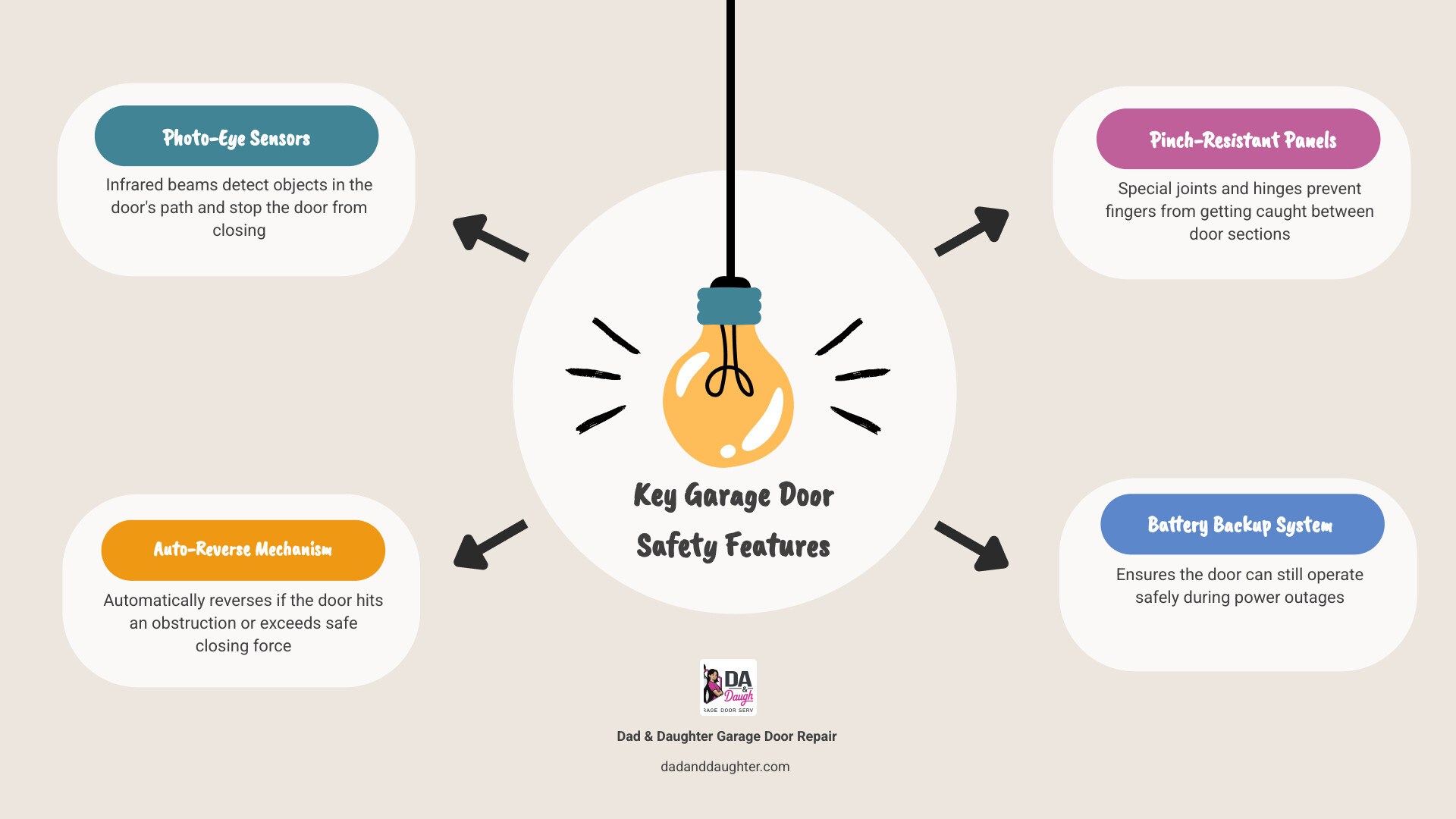
What garage door safety features protect your family from accidents comes down to a handful of critical systems — and knowing what they are could prevent a serious injury in your home. Here’s a quick overview:
| Safety Feature | What It Does |
|---|---|
| Photo-eye sensors | Detect people, pets, or objects in the door’s path and stop the door |
| Auto-reverse mechanism | Reverses the door automatically if it contacts an obstruction |
| Pinch-resistant panels | Prevent fingers from getting caught between door sections |
| Manual release handle | Lets you open the door manually during a power outage |
| Battery backup system | Keeps the door operating when the power goes out |
| Rolling code technology | Changes the remote access code after every use to block unauthorized entry |
Your garage door is likely the largest and heaviest moving object in your home — often weighing between 150 and 400 pounds — and it moves up and down roughly 1,500 times a year. According to the U.S. Consumer Product Safety Commission, approximately 30,000 people are injured by garage doors every year in the United States. Children and pets are especially vulnerable.
The good news? Modern garage doors come equipped with multiple layers of protection designed specifically to prevent these accidents. But only if those features are working correctly — and many homeowners have no idea whether theirs are.
This guide walks you through every safety feature you need to know about, how to test them, and when to call a professional.
The Hidden Risks of Older Garage Doors

If your home in the Nashville area was built several decades ago, or if you haven’t upgraded your garage door opener in a long time, you could be living with a ticking time bomb. In the late 1980s and early 1990s, garage doors and automatic operators were associated with an estimated 20,000 emergency department-treated injuries annually. Many of these accidents involved young children who were trapped and crushed under heavy doors that lacked modern safety mechanisms.
The primary risk of pre-1993 garage door openers is the complete lack of non-contact safety sensors. Before federal mandates took effect, if a garage door was closing, it would keep closing until it hit the floor—or whatever (or whoever) happened to be in its path. Even if an older opener had a mechanical limit switch, it often required massive downward pressure to trigger a reversal, which was far too heavy for a child or a small pet to survive without severe injury.
Another major hazard of older systems is spring failure. Garage door springs—whether they are torsion springs mounted above the door or extension springs running along the sides—are under an immense amount of tension. Over years of lifting a heavy door, the steel in these springs fatigues.
When an older extension spring snaps without a safety containment cable running through its center, it essentially becomes a high-velocity projectile. We have seen broken springs shatter car windshields, dent drywall, and cause catastrophic bodily harm to anyone standing nearby.
If your door is heavy to lift manually, makes grinding noises, or lacks safety beams at the base of the tracks, it is time to seek professional help. If you suspect your vintage system is putting your family at risk, scheduling a comprehensive inspection with a team specializing in Garage Door Repair Nashville Area is the best way to identify and resolve these hidden dangers before an accident occurs.
What Garage Door Safety Features Protect Your Family from Accidents?
To understand how modern garage doors prevent injuries, we have to look at the regulatory backbone of the industry: the UL 325 standard and federal safety regulations.
In 1990, the U.S. Congress passed the Residential Garage Door Safety Act, which mandated that all residential automatic garage door operators manufactured or imported for sale in the United States after January 1, 1993, must feature an inherent primary entrapment protection system (like automatic reversal) as well as secondary protection (such as photoelectric sensors or edge sensors).
These two technologies work together as a redundant, dual-protection system to ensure that if one layer fails, the other is there to stop the door.
| Feature | Primary Detection Method | Reaction Time | Primary Target |
|---|---|---|---|
| Photo-Eye Sensors | Non-contact (Infrared light beam interruption) | Instantaneous (Stops and reverses before contact) | Children, pets, toys, cars |
| Auto-Reverse Mechanism | Contact-based (Measures resistance/force on the motor) | Must reverse within 2 seconds of contact | Obstacles already in the door’s physical path |
Photo-Eye Sensors and the Six-Inch Rule
Photo-eye sensors are your garage door’s first line of defense. These small, camera-like devices are mounted on both sides of the garage door track, sending an invisible infrared beam across the opening. If anything breaks this beam while the door is closing, the operator instantly halts downward travel and reverses the door back to the fully open position.
However, these sensors are only effective if they are installed at the correct height. Under UL 325 standards, photo-eyes must be mounted no higher than six inches above the garage floor. This “six-inch rule” is based on the average height of a crawling infant’s head or a small pet. If the sensors are mounted too high—say, twelve inches off the ground—a toddler crawling under the door or a family dog lying in the entryway could easily pass beneath the beam undetected, leaving them vulnerable to a closing door.
In places like Gallatin, TN, local environmental factors can also play a role in sensor performance. Dust, grass clippings, and shifting temperatures can cause the delicate infrared lenses to get dirty or fall out of alignment. When this happens, your door may refuse to close at all, continuously reversing because it detects a “ghost” obstruction.
Keeping these lenses clean and checking their alignment is a simple but vital part of home safety. For a deeper look at how local weather and maintenance affect your garage door’s performance, consult our Garage Door Service Guide Gallatin TN.
Auto-Reverse Mechanisms and Force Sensitivity
While photo-eyes prevent contact entirely, the mechanical auto-reverse system acts as a crucial fail-safe. If a child or object is positioned in a way that avoids the photo-eye beam, the auto-reverse system takes over the moment the bottom edge of the door meets even slight physical resistance.
Inside the garage door opener’s motor casing is an electronic board that monitors the force required to move the door. Under UL 325 guidelines, the closing force of a residential garage door must never exceed 20 pounds. If the door encounters an obstruction that requires more than 20 pounds of resistance to overcome, the internal logic board registers this spike in electrical current and reverses the door’s direction within two seconds.
Problems arise when homeowners try to adjust these force settings themselves. Over time, as a garage door’s rollers wear out or the tracks become misaligned, the door becomes harder to push and pull. Some well-meaning DIYers attempt to compensate for this mechanical friction by turning up the force limit adjustment screws on the back of the opener.
This is incredibly dangerous. Increasing the force limits defeats the auto-reverse safety feature, requiring the door to slam down with much more than 20 pounds of force before it decides to reverse. Instead of forcing a struggling opener to work harder, the underlying mechanical issue—such as worn rollers or unbalanced springs—must be addressed by a professional.
Physical and Mechanical Protection for Children and Pets
While sensors and reversing motors provide electronic safety, the physical construction of the door itself plays a major role in keeping little hands and paws safe.
Historically, one of the most common garage door injuries involved fingers getting crushed in the horizontal gaps between door panels as the door curved around the track. Children often place their fingers in these gaps out of curiosity or while helping to close a manual door, leading to severe pinch injuries or amputations.
Pinch-Resistant Panels and Finger Protection
To combat this hazard, modern garage door manufacturers designed pinch-resistant panels. These panels utilize a patented tongue-and-groove joint profile. As the door folds and unfolds while opening or closing, the curved shape of the panel edges naturally pushes fingers outward and away from the closing gap rather than pinching them inside.
Additionally, modern high-quality doors feature tamper-resistant bottom brackets and enclosed hinges. Because the bottom brackets of a garage door are connected directly to the high-tension cables that lift the door, tampering with them without releasing spring tension can cause them to fly off with lethal force.
Enclosed hinges and pinch-resistant designs ensure that even if a child touches the moving parts of the door, there are no open pinch points to catch their clothing or fingers.
If you are upgrading an older, dangerous paneled door to a modern, child-safe model, choosing a professional team ensures that these advanced physical safety features are aligned perfectly. You can explore safe, durable options by visiting our page on Garage Door Installation Nashville Area.
What Garage Door Safety Features Protect Your Family from Accidents During Power Outages?
A sudden power outage in the middle of a Tennessee summer storm can turn a convenient automatic garage door into an impassable barrier. If you need to evacuate your home in an emergency, or if you simply need to get your car out of the garage to get to work, you must rely on manual safety overrides.
Every modern garage door opener features a manual release handle—usually a bright red cord hanging from the trolley assembly on the overhead rail. Pulling this cord disengages the motor carriage from the drive chain or belt, allowing you to lift and lower the heavy door by hand.
However, there are two major safety considerations with the manual release:
- The Door Must Be Fully Closed Before Pulling the Cord: If you pull the manual release cord while the door is partially open, and the door has a broken or weakened spring, the door will crash down instantly with the full force of its uncounterbalanced weight. This can easily crush anyone standing beneath it.
- Security Risks: Intruders have been known to use a wire coat hanger slipped through the top weather stripping of a garage door to hook and pull the manual release handle from the outside. To prevent this, you can install a simple shield or secure the lever, but ensure it remains accessible to your family in an emergency.
To completely eliminate the stress of manual operation during an outage, many homeowners choose openers equipped with battery backup systems. Originally popularized by California’s SB 969 legislation—which mandated battery backups on all residential openers to prevent residents from being trapped in garages during fast-moving wildfires—battery backups have become a highly sought-after safety feature nationwide.
A built-in lithium-ion battery backup ensures that even if the local power grid goes down, your garage door will still cycle reliably up to 50 times, keeping your family safe, secure, and mobile when it matters most.
Testing and Maintaining Your Garage Door Safety Systems
Having safety features installed on your garage door is only half the battle; ensuring they actually work when needed is the other. Because a garage door moves thousands of times a year, the constant vibration naturally loosens hardware, stretches cables, and shifts sensors out of alignment.
Establishing a routine maintenance schedule is the single best way to protect your home. For practical maintenance advice you can perform yourself, check out our Garage Door Repair Tips Gallatin TN.
How to Test What Garage Door Safety Features Protect Your Family from Accidents
We recommend performing a quick, 15-minute safety inspection on your garage door at least once a month. You do not need specialized tools to do this—just a standard 2×4 wood block and a little bit of time.
1. The 2×4 Reversal Test (Testing the Auto-Reverse)
- Step 1: Open your garage door completely.
- Step 2: Place a solid 2×4 wood block flat on the garage floor directly in the center of the door’s path.
- Step 3: Press your remote or wall button to close the door.
- Step 4: Watch the door closely. As soon as the bottom edge of the door strikes the wood block, it should pause and immediately reverse back to the open position.
- If the door strikes the block, keeps pushing, or tries to crush the wood without reversing, your opener’s force settings or travel limits are set too high, and the system is unsafe.
2. The Sensor Block Test (Testing the Photo-Eyes)
- Step 1: Start closing your garage door.
- Step 2: While the door is in motion, wave a long object (like a broomstick) through the path of the infrared beam near the floor. Never use your leg or hand to block the beam.
- Step 3: The door should instantly stop and reverse.
- Step 4: Verify that the indicator lights on both sensors are solid (usually green and amber). If one light is blinking or dark, the sensors are misaligned or dirty.
3. The Balance Check (Testing the Counterbalance Springs)
- Step 1: Close the garage door completely.
- Step 2: Pull the red manual release cord to disengage the opener.
- Step 3: Lift the door manually by hand. It should lift smoothly with minimal effort (you should be able to lift it with one hand).
- Step 4: Raise the door halfway and let go.
- A perfectly balanced door will stay suspended in place, supported by the springs. If the door slams shut or shoots upward, the springs are out of balance and require professional adjustment.
The Importance of Professional Safety Inspections
While monthly testing is easy for homeowners to manage, some components of your garage door system are simply too dangerous to handle without specialized training and tools.
The springs and cables that balance your door store an incredible amount of energy. A standard residential torsion spring can hold up to 10,000 foot-pounds of torque. If a winding bar slips during a DIY spring adjustment, or if a high-tension bottom bracket is unscrewed while the spring is wound, the resulting release of energy can shatter bones, sever fingers, or cause fatal head injuries.
We strongly advise homeowners to leave all spring, cable, and structural repairs to trained technicians. A professional technician does not just look at whether the door opens and closes; they use calibrated equipment to test force settings, check the structural integrity of the steel cables for microscopic fraying, and ensure the entire system complies with modern UL 325 safety standards.
An annual professional safety tune-up is a small investment that provides invaluable peace of mind for your family.
Frequently Asked Questions about Garage Door Safety
If you want to learn more about keeping your system in top shape, you can browse our comprehensive list of Frequently Asked Questions Nashville Area. In the meantime, here are some of the most common questions we hear from local families:
How often should I test my garage door’s safety features?
You should test your garage door’s safety sensors and automatic reversal mechanism once a month. Additionally, you should perform these tests after any major storm, power outage, or if you notice the door moving irregularly or making unusual noises. Cleaning the photo-eye lenses with a soft, dry cloth should be done every few months to prevent dust and spiderwebs from blocking the infrared beam.
Can I repair or adjust garage door springs myself?
No. You should never attempt to repair, adjust, or replace garage door springs or cables yourself. Because these components are under thousands of pounds of tension, mishandling them is one of the leading causes of severe emergency room injuries related to home maintenance. Always call a licensed, insured professional who has the correct winding bars, safety gear, and replacement parts rated for your specific door weight.
What should I do if my garage door safety sensors are blinking?
If your photo-eye sensors are blinking red or yellow instead of glowing solid, it indicates that the infrared beam is interrupted or misaligned.
- First, check for any physical obstructions like trash cans, toys, or cobwebs.
- Next, wipe the lenses clean of dust.
- Finally, gently loosen the mounting bracket of the blinking sensor and nudge it until the indicator light turns solid, then tighten the bracket back down. If the blinking persists, there may be a short or damage in the low-voltage wiring connecting the sensors to the opener.
Conclusion
At the end of the day, your garage door is a heavy piece of machinery that operates right in the middle of your family’s daily life. Ensuring that its safety features are modern, compliant, and fully operational is the best way to keep your kids, pets, and vehicles safe from devastating accidents.
At Dad & Daughter Garage Door Repair, we have been serving families across the Nashville area—including Smyrna, TN, Gallatin, TN, Murfreesboro, TN, and Franklin, TN—since 1996. As a local, family-owned company, we do not answer to private equity firms or corporate shareholders. We answer to you. Our focus has always been on providing honest, high-quality, and reliable service to our neighbors.
Whether you need a quick safety inspection, an upgrade to a child-safe modern door, or a fast repair on a malfunctioning sensor, we are here to help. Contact our friendly team today to schedule an inspection and make sure your home is as safe as it can possibly be.
To book your safety evaluation or repair, visit our Garage Door Repair Nashville Area page today.
Need Help?
Contact us today to discuss your needs. Our team is ready to help.
About the Author
Dad And Daughter Garage Door Service
More Articles
View All PostsRelated Articles

Upgrading Weatherstripping Before the First Frost
Summer heat bakes garage door rubber, making it vulnerable to freezing directly to your driveway. Catching these cracked seals in September protects your opener motor from sudden mechanical failure.
Read Article
The Importance of Professional Track Alignment After an Impact
Accidentally bumped your garage track with the car? Pounding the metal straight might look like a quick fix, but microscopic bends will silently shred your rollers and burn out the motor.
Read Article
Troubleshooting a Blinking Light on Your Garage Door Opener
That repetitive flashing overhead isn't a glitch—it's a diagnostic code. Decode your opener's LED signals to see if you can clear a blocked sensor or if you need professional repair.
Read ArticleReady to Get Started?
Whether you need a repair, maintenance, or a new installation, our expert team is here to help.