Why Garage Door Springs Break: A Detailed Guide
Dad And Daughter Garage Door Service

Learn why garage door springs break and how often it happens plus warning signs and prevention tips.
Why Garage Door Springs Break: A Detailed Guide
Why Garage Door Springs Break and How Often It Happens: What You Need to Know
Why garage door springs break and how often it happens is one of the most common questions homeowners ask after hearing a loud bang from their garage — or finding their door suddenly stuck in place.
Here’s a quick answer before we dive deeper:
Why garage door springs break:
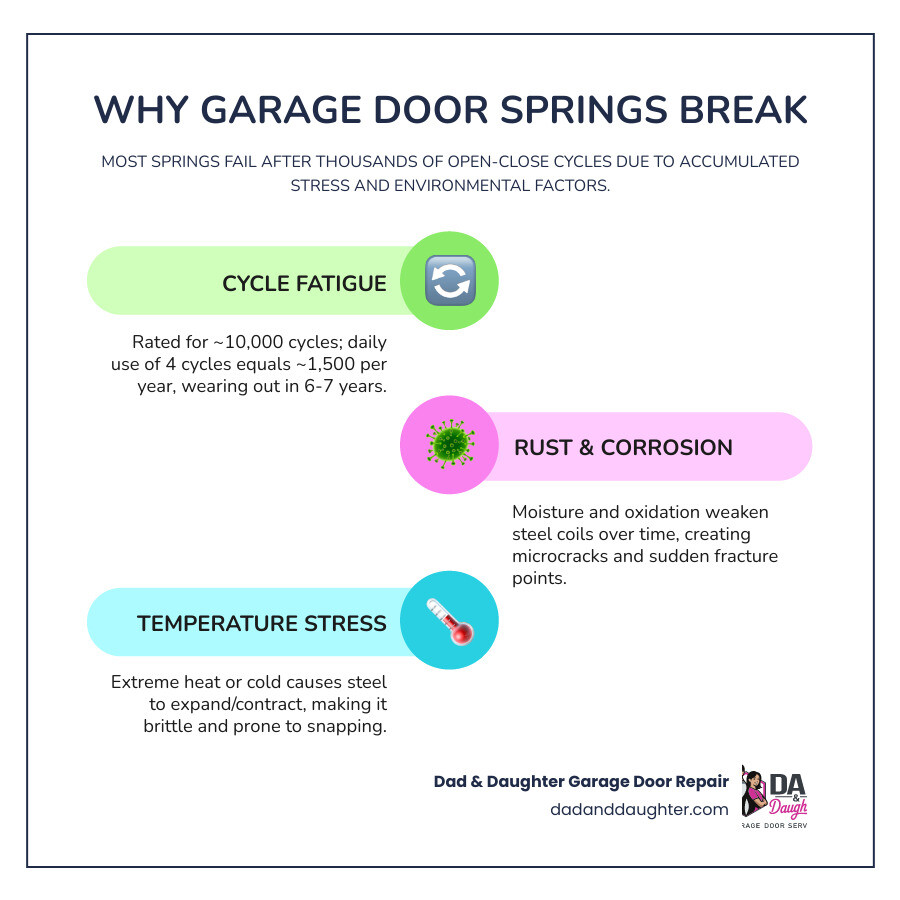
- Normal wear from repeated open-and-close cycles (most springs are rated for ~10,000 cycles)
- Rust and corrosion weakening the metal coils over time
- Lack of lubrication increasing friction and accelerating wear
- Extreme temperature changes making steel brittle
- Improper installation or incorrect spring sizing
- High daily usage exhausting cycle life faster than expected
How often it happens:
- Average spring lifespan: 7 to 10 years for typical household use
- At 4 cycles per day, that’s roughly 1,500 cycles per year — meaning a standard spring could wear out in as little as 6 to 7 years
- Homes with 10+ daily cycles can burn through a spring in 2 to 3 years
- Heavy-duty springs (rated for 25,000+ cycles) last significantly longer
Most failures aren’t truly random. Springs store enormous tension every time your garage door closes — and that stress quietly accumulates cycle after cycle, often for years, before something finally gives. Cold mornings, a little surface rust, or one too many cycles can be all it takes to push a worn spring past its limit.
If your door has stopped working or you suspect your springs are getting close to the end of their life, the sections below break down exactly what’s happening inside those coils — and what you can do about it.
Understanding Torsion vs. Extension Springs
Before we can look at why these parts fail, we have to understand the two main types of systems holding up your garage door. While both rely on the fundamental physics of storing and releasing potential energy, they do so in very different ways.
Torsion Springs
Torsion springs are the modern standard for safety and durability. They are mounted horizontally on a solid steel shaft directly above the garage door opening. When the door closes, cables attached to the bottom corners of the door wind around drums at each end of the steel shaft, winding the spring tightly and storing immense torque. When you open the door, that wound-up potential energy unwinds, spinning the shaft and easily lifting the heavy door.
Because torsion springs slide onto a shaft, they remain safely contained if they snap, spinning harmlessly in place rather than flying loose.
Extension Springs
Common in older homes or garages with low headroom, extension springs are mounted on either side of the overhead tracks. Instead of winding, they stretch out parallel to the tracks as the door closes.
Because extension springs act like giant, highly tensioned rubber bands, they are incredibly volatile when they break. If they snap without heavy-duty safety cables running through the center of the coils, they can fly off their mounts like missiles. This can easily smash through car windshields, dent walls, or cause severe, life-threatening injuries to anyone standing nearby.
To learn more about how these two systems compare in real-world performance, check out our guide on Torsion vs Extension Garage Door Springs Knoxville TN.
Torsion vs. Extension Springs at a Glance
| Feature | Torsion Springs | Extension Springs |
|---|---|---|
| Mounting Location | Horizontally above the door opening | Along the horizontal tracks on both sides |
| Mechanism | Winds and unwinds (torque) | Stretches and contracts (tension) |
| Average Lifespan | 10,000 to 20,000+ cycles (7–10 years) | 7,000 to 10,000 cycles (5–7 years) |
| Safety Level | High (contained on a steel shaft) | Low (requires safety cables to prevent flying debris) |
| Operation | Smooth, balanced, and quiet | Tends to jerk, squeak, and wear unevenly |
Why Garage Door Springs Break and How Often It Happens
To understand why garage door springs break and how often it happens, we have to look closely at the molecular structure of the metal itself. Every time your garage door goes up and down, it completes one full “cycle.”
The Physics of Metal Fatigue
According to Hooke’s Law, the force required to extend or compress a spring is directly proportional to the distance it is stretched. In practical terms, this means your garage door springs are under the absolute maximum amount of tension when the door is completely closed.
When the door is down, the steel is stretched or wound to its physical limit. This is why almost all garage door springs snap when the door is in the closed position, often making a sound like a gunshot in the middle of the night or early in the morning when the house is quiet.
Behind the scenes, this constant cycling causes microscopic metal fatigue. Each time the spring winds and unwinds, tiny, invisible microcracks form within the high-carbon steel wire. For the first few thousand cycles, these microcracks are completely unnoticeable. However, as the door continues to operate, the mechanical stress concentrates at these microscopic fracture points. Eventually, one of these tiny cracks reaches a critical threshold, and the entire spring snaps in a fraction of a second.
If you are currently dealing with a snapped spring and the stress of a trapped car, we can help restore your peace of mind. Read more about how When the Springs Break So Should Stress with Nashville TN Garage Door Service to see how easy the recovery process can be with the right local team.
The Primary Culprits Behind Spring Failure
While natural metal fatigue is inevitable, several environmental and mechanical factors can dramatically accelerate the process.
Rust and Corrosion
Rust is the ultimate silent killer of garage door springs. When moisture in the air settles on raw steel, it creates iron oxide. This rust does two things:
- Increases Coil-to-Coil Friction: As a torsion spring winds and unwinds, the individual coils press tightly against one another. If those coils are coated in rough rust, the friction increases significantly, making the opener work harder and putting extra shear stress on the steel.
- Creates Stress Concentrations: Rust eats microscopic pits into the surface of the metal. These tiny pits act as perfect starting points for microcracks, multiplying local stress levels by three to five times and causing the spring to fail long before its rated cycle limit.
Lack of Lubrication
Without a protective barrier of high-quality lubricant, the raw steel coils will constantly grind against each other. This friction generates heat, wears down the wire diameter, and invites rust to take hold. Skipping basic lubrication is one of the quickest ways to cut a spring’s life in half.
Temperature Extremes and Thermal Cycling
Our Middle Tennessee weather can be incredibly tough on garage doors. From hot, humid summer afternoons in Brentwood and Franklin to freezing winter mornings in Bellevue and Gallatin, our doors experience severe temperature swings.
When garage interiors heat up to 130°F or more in the summer, any cheap or low-quality lubricants on the springs can melt and run off, leaving the metal completely exposed. Conversely, extreme cold in the winter causes the steel to contract and become less ductile, meaning it loses some of its ability to bend without breaking.
To learn more about how our local climate impacts your home’s garage system, explore The Ultimate Guide to How Heat and Humidity Affect Garage Door Springs.
How Often It Happens: Calculating Your Spring’s Lifespan
How often you have to replace your springs is a simple math equation based on daily usage.
Let’s look at how typical household habits translate to real-world spring life:
- The Low-Usage Household (1–2 cycles/day): If you only use your garage door to pull your car out in the morning and put it away at night, you are running about 500 to 700 cycles per year. A standard 10,000-cycle spring can easily last 10 to 15+ years under these light conditions, provided it is kept lubricated and rust-free.
- The Average Busy Family (4 cycles/day): This is the standard baseline. Between commuting to work, running errands, and coming home, you’ll complete roughly 1,500 cycles per year. Under this normal wear and tear, standard springs will typically break in 5 to 7 years.
- The High-Traffic Household (8–10+ cycles/day): If you use your garage as your primary home entrance, have kids playing outside, or run a home business, those cycles add up fast. At 10 cycles a day, you will hit 3,650 cycles a year, meaning standard springs will fail in just 2 to 3 years.
If your home falls into the high-traffic category, standard springs will feel like a recurring headache. In these cases, we highly recommend upgrading to heavy-duty or extended-life springs. These springs are wound from thicker wire and are engineered to handle 25,000 to 50,000 cycles, comfortably lasting 15 to 20 years even under heavy daily use.
Why Garage Door Springs Break and How Often It Happens in Cold Weather
Have you ever noticed that garage door springs seem to snap most often on the coldest mornings of the year? This isn’t just a coincidence; there is a very real scientific explanation for it.
As temperatures drop during a Middle Tennessee cold snap, steel loses its fracture toughness. The metal becomes brittle and less forgiving of the intense bending stresses required by a torsion system.
At the same time, the cold grease inside your door’s rollers and tracks thickens, creating extra resistance. When your garage door opener attempts to lift the door against this added drag, it places a massive surge of sudden tension on the brittle, cold spring. If the spring already has microscopic wear or surface rust, that cold-weather strain is often the final straw that triggers a sudden, explosive break.
Recognizing the Warning Signs of a Failing Spring
While a broken spring might feel like it happened completely out of nowhere, your garage door system almost always drops subtle hints weeks or months before a failure occurs. Knowing what to look and listen for can save you from getting your car trapped inside your garage.
- The Loud “Gunshot” Sound: If you are home when a spring breaks, you will hear a massive, echoing bang coming from the garage. Many homeowners mistake this sound for a break-in, a gunshot, or a falling shelf.
- The Door Refuses to Lift: If you press your wall button and the motor hums or struggles for a second before shutting off, check the springs. Without the counterbalance of the springs, your garage door opener simply does not have the horsepower to lift a 150-to-300-pound door.
- The “Four-Inch Stop”: Many modern garage door openers have safety sensors that detect excessive weight. If your door opens about three to four inches and then immediately stops or reverses, the opener is sensing that the door is far too heavy because a spring has snapped.
- A Visible Gap in the Coils: Take a look at the metal spring above your door. If you see a clear two-to-three-inch gap where the steel coil has separated into two pieces, the spring is broken and must be replaced.
- Uneven or Crooked Liftoff: If you have an extension spring system and one side breaks, the door will lift unevenly, binding in the tracks and hanging crookedly.
- Loose, Sagging Cables: When a spring snaps, all tension is lost instantly. This often causes the lifting cables on the sides of the door to unravel from their drums, hanging down like loose pieces of string.
For a deeper look at these warning signs so you can catch them early, read our helpful article on the Top Signs Garage Door Spring Needs Repair Brentwood TN.
Why Garage Door Springs Break and How Often It Happens Due to Poor Maintenance
A shocking number of premature spring failures can be traced back to simple neglect. When a garage door system is ignored, small mechanical issues quickly snowball into major problems that destroy your springs.
For example, if your tracks are slightly misaligned, or if your rollers are worn out and binding, the door will not roll smoothly. This physical resistance acts as an anchor, forcing the springs to work twice as hard to lift the door. This extra load can easily cut 3,000 to 4,000 cycles off your spring’s overall lifespan.
Regular inspections are the best defense against these hidden issues. To understand why proactive care is so critical, check out our guides on Regular Service Garage Door Springs Extends Lifespan Brentwood TN and the Importance Servicing Garage Door Springs Before Break Franklin TN.
Prevention and Professional Maintenance
While you can’t stop metal fatigue entirely, you can easily push your springs to the absolute limit of their rated lifespan with a few simple maintenance habits.
The Ultimate Preventative Maintenance Checklist
To keep your garage door operating smoothly and safely, we recommend performing these quick checks at least twice a year:
- Apply Silicone-Based Lubricant: Spray your springs, rollers, and hinges every six months. Avoid heavy grease or WD-40, which can attract dirt and abrasive dust that wears down the metal.
- Perform a Balance Test: Disconnect your garage door opener by pulling the red emergency release cord. Manually lift the door to waist height and let go. If the door stays in place or gently drifts, it is perfectly balanced. If it slams down or shoots upward, the spring tension is incorrect and needs professional calibration.
- Inspect for Rust: Visually check the coils for any signs of orange rust. If you see light surface rust, wipe it down with a rag soaked in silicone lubricant to stop the corrosion in its tracks.
- Listen Closely: Pay attention to the sounds your door makes. Grinding, squeaking, or popping noises are clear indicators that your system is fighting friction and putting extra stress on your springs.
- Keep Tracks Clean: Sweep out any leaves, dirt, or debris from your vertical and horizontal tracks to prevent the rollers from binding.
For a complete checklist and expert tips on keeping your system in peak condition, explore our guide on Garage Door Service Maintenance Thompsons Station TN.
Frequently Asked Questions about Garage Door Springs
Can I replace a garage door spring myself?
No. We strongly advise against attempting DIY garage door spring replacement. Torsion springs must be wound under extreme mechanical tension using specialized steel winding bars. One slip of a tool or a loose set screw can instantly release hundreds of pounds of force, causing severe fractures, facial injuries, or loss of fingers. Over 30,000 garage-door-related injuries occur in the U.S. every year, and many of the most severe are caused by DIY spring repairs. This is one home project that is always best left to trained, insured professionals.
Should both springs be replaced at the same time?
Yes, absolutely. Most residential garage doors are installed with a matching pair of springs. Both springs have experienced the exact same number of open-and-close cycles and have lived in the same temperature and humidity conditions. If one spring has reached the end of its life and snapped, the remaining spring has the exact same amount of metal fatigue and will almost always break within a few weeks or months. Replacing both at the same time keeps the door balanced and saves you from paying for a second service call down the road.
How does door weight affect spring lifespan?
Your springs must be precisely calibrated to the exact weight of your garage door. A standard single-layer steel door might only weigh 130 pounds, while a heavy, insulated carriage-house door with wood overlays can easily weigh over 300 pounds. If a replacement spring is even slightly undersized or wound too tightly to compensate for a heavy door, it will operate under excessive shear stress. This miscalibration can cause a standard 10,000-cycle spring to fail in as little as 3,000 to 4,000 cycles.
Conclusion
Understanding why garage door springs break and how often it happens is the first step toward protecting your home, your vehicles, and your family. While every spring will eventually reach its physical limit and snap, regular lubrication, seasonal balance tests, and prompt professional attention can keep your garage running safely for a decade or more.
At Dad & Daughter Garage Door Repair, we have been serving our Middle Tennessee neighbors since 1996. As a family-owned, locally operated company without private equity backing, we are proud to offer honest, high-quality care across our local service areas, including Smyrna, Murfreesboro, Hendersonville, Mt. Juliet, Franklin, Brentwood, and Thompson’s Station. We believe in doing the job right the first time — treating your home with the same care and respect we would show our own.
If you’ve heard that telltale loud bang from your garage, or if your door is acting heavy and sluggish, don’t wait for a complete breakdown. Schedule professional garage door repair in the Nashville area with our friendly, experienced team today, and let us handle the heavy lifting for you!
Need Help?
Contact us today to discuss your needs. Our team is ready to help.
About the Author
Dad And Daughter Garage Door Service
More Articles
View All PostsRelated Articles

Troubleshooting a Blinking Light on Your Garage Door Opener
That repetitive flashing overhead isn't a glitch—it's a diagnostic code. Decode your opener's LED signals to see if you can clear a blocked sensor or if you need professional repair.
Read Article
Why Nashville Building Codes Dictate Specific Wind Load Ratings
An unbraced garage door is the largest structural vulnerability during severe weather. See exactly what local inspectors look for to ensure your new build meets current wind load requirements.
Read Article
The Cost Difference Between Stamped Steel and Custom Wood Doors
Choosing between custom wood and steel means looking past the initial estimate. Understand the lifetime maintenance realities of each material before your next exterior upgrade.
Read ArticleReady to Get Started?
Whether you need a repair, maintenance, or a new installation, our expert team is here to help.