
How to Diagnose a Garage Door Opener Grinding Noise
Dad And Daughter Garage Door Service

Learn what garage door opener makes grinding noise what that usually means and how to safely diagnose and fix the issue before calling a pro.
How to Diagnose a Garage Door Opener Grinding Noise
What a Garage Door Opener Grinding Noise Usually Means
If your garage door opener makes a grinding noise, here is what that usually means at a glance:
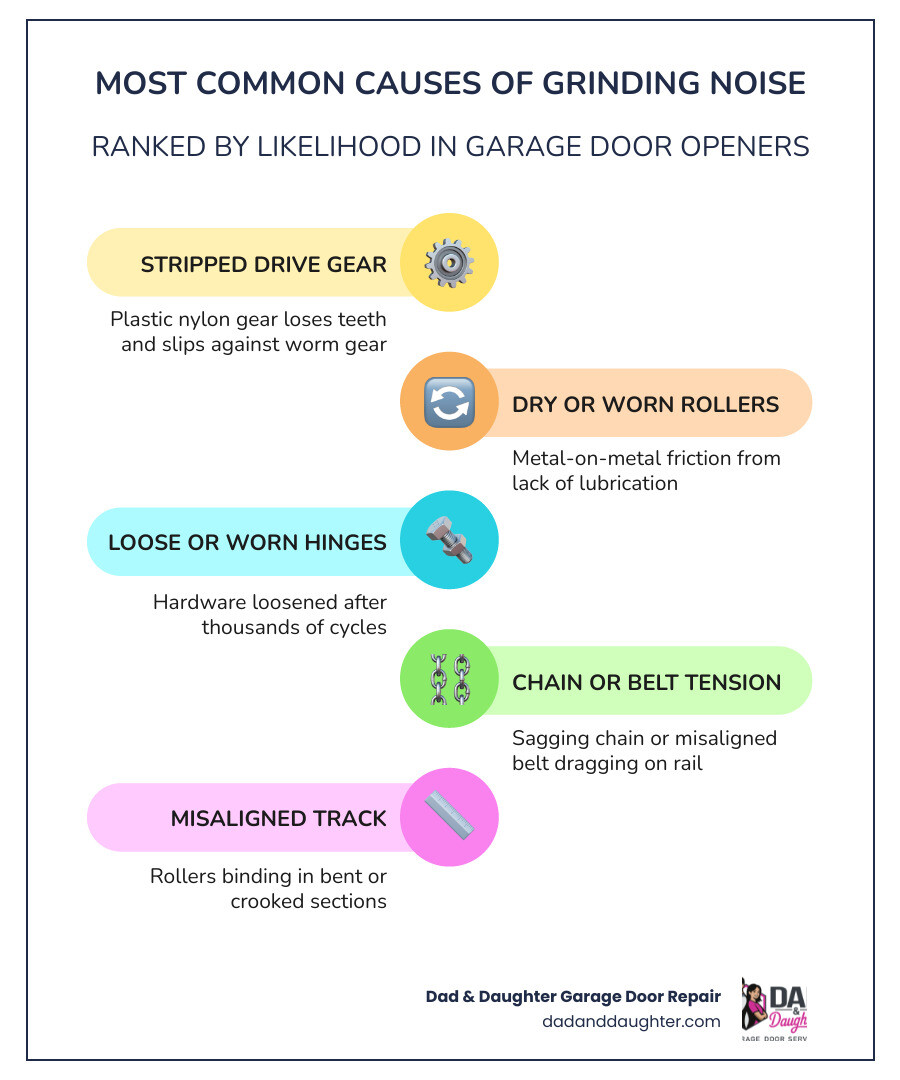
Most common causes, ranked by likelihood:
- Stripped or worn drive gear – The plastic nylon gear inside the opener has lost its teeth and is slipping against the worm gear
- Dry or worn rollers – Metal-on-metal friction as rollers move through the tracks without lubrication
- Loose or worn hinges – Hardware that has worked itself loose over thousands of cycles
- Chain or belt tension issues – A saggy chain or misaligned belt dragging and grinding against the rail
- Misaligned or bent track – Rollers binding as they push through a section of track that is no longer straight
That grinding sound you hear every morning is your opener telling you something is wrong — and it usually will not fix itself.
A garage door that gets used three or four times a day logs over 1,000 cycles every year. That is a lot of stress on plastic gears, metal rollers, and lubricated parts that were not designed to run dry. Most grinding noises come down to a handful of very common failure points, and catching them early is almost always cheaper than waiting for a complete breakdown.
At Dad & Daughter Garage Door Repair, we hear this complaint constantly from Nashville-area homeowners. The good news? Most causes are diagnosable in under 10 minutes — and several can be fixed the same day.
Garage Door Opener Makes Grinding Noise What That Usually Means
When your garage door opener makes a grinding noise, it almost always points to a mechanical conflict where moving parts are no longer meshing, rolling, or sliding smoothly. A healthy garage door opener is designed to run relatively quietly, but when friction takes over, the system starts crying out for help.
Most modern garage door openers rely on a series of sacrificial parts. Manufacturers intentionally design certain components—like the main drive gear—out of high-strength nylon or plastic. This design principle ensures that if the garage door becomes too heavy (often due to a broken torsion spring or extreme track binding), the plastic gear teeth will strip away first. This “sacrificial” failure protects the expensive electric motor from overheating, seizing, or catching fire.
If you ignore the sound, that minor friction can rapidly accelerate into a complete system failure, leaving your car trapped inside your garage. To understand how these intermittent mechanical issues develop over time, check out our detailed guide on How to Diagnose Intermittent Garage Door Opener Problems.
Why a Garage Door Opener Makes Grinding Noise What That Usually Means for Your Gears
If the grinding sound is coming directly from the motor unit hanging from your ceiling, the prime suspect is almost certainly the main drive gear.
Inside the motor housing, a steel worm gear on the motor shaft drives a larger, circular nylon gear. Over 10 to 15 years of daily operation—or much sooner if the door is unbalanced—the teeth on this nylon gear can wear down, chip, or completely strip away.
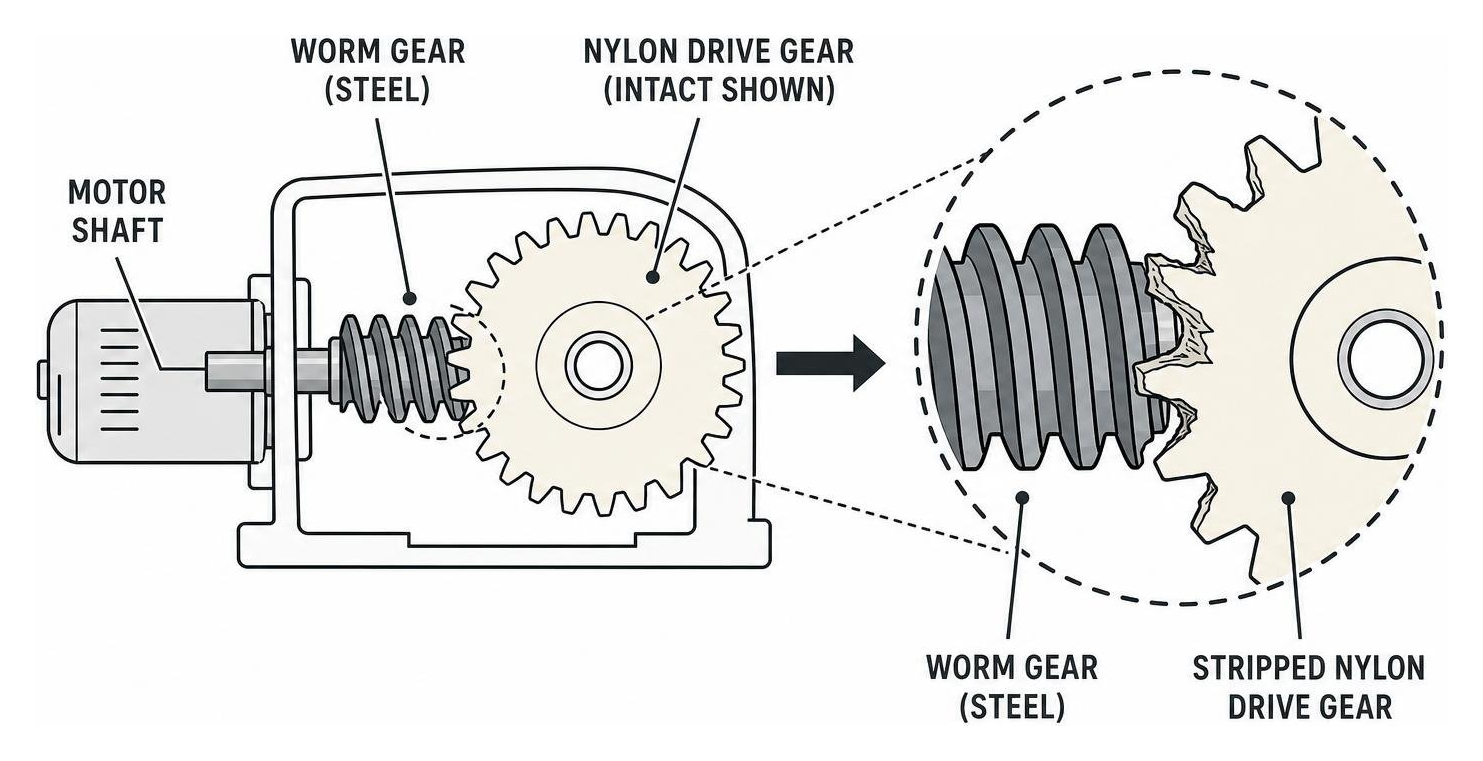
When this happens, you will notice very specific symptoms:
- The “Snow” Effect: If you remove the plastic cover of the motor unit, you will often find a pile of white plastic shavings or white powder resembling snow resting inside the housing or on the light lens.
- Motor Spinning Without Movement: You can hear the electric motor running, humming, or spinning, but the chain, belt, or screw drive does not move at all, and the garage door remains stationary.
- Warm Plastic Smell: The friction of a spinning metal worm gear grinding against a stripped nylon gear can create a distinct warm, burning plastic odor.
If your gears are stripped, you will need to evaluate whether it is smarter to repair the internal gear kit or replace the entire motor head. For a deep dive into making this decision for your home, read our guide on Repair vs Replace Garage Door Motor Nashville TN.
When Your Garage Door Opener Makes Grinding Noise What That Usually Means for Home Safety
A grinding garage door opener is not just an auditory nuisance; it is a safety hazard. When components inside your drive system begin to slip or grind, the opener loses its ability to control the door’s descent reliably.
The safety implications vary slightly depending on your opener’s drive type:
- Chain Drive Openers: A loose, saggy chain can jump off the drive sprocket at the top of the motor head. If the chain becomes tangled or slips while the door is mid-travel, it can cause the door to crash down unexpectedly.
- Belt Drive Openers: While incredibly quiet, a belt drive can experience “tooth shear” where the rubber teeth on the inner side of the belt strip away, causing the belt to slip wildly over the drive sprocket with a loud, rapid chattering or grinding sound.
- Screw Drive Openers: These systems use a threaded steel rod to move the trolley. If the drive coupler connecting the motor shaft to the screw rod breaks, or if the teeth inside the trolley carriage wear down, the screw will spin uselessly, creating a loud buzzing or screeching sound.
If any of these drive mechanisms fail completely, the door can drop suddenly. Furthermore, a straining motor can fail to trigger the automatic safety reversal system if an object or person blocks the door’s path. For residents in Murfreesboro and surrounding areas experiencing these critical issues, we recommend reading our specialized article on Garage Door Motor Repair Murfreesboro TN to understand how to restore safe operation.
How to Safely Inspect and Diagnose the Source of the Noise
Before you start turning screws or spraying lubricants, you must safely isolate whether the grinding noise is coming from the opener motor itself or the physical door hardware.

Follow this step-by-step diagnostic process:
Step 1: Close the Door and Pull the Emergency Release
Always start with the garage door in the fully closed position. Pull the red emergency release cord down and back toward the motor unit to disconnect the opener carriage from the door.
- Safety Warning: Never pull the emergency release cord if the door is stuck open. If a spring is broken, the door could instantly crash down with hundreds of pounds of force.
Step 2: Perform a Manual Door Balance Test
With the door disconnected, lift it manually by hand. A properly balanced garage door should:
- Feel incredibly light (you should be able to lift it with one hand using about 10 to 15 pounds of force).
- Stay in place when you let go of it halfway up (around three to four feet off the ground).
- If the door feels incredibly heavy (like it weighs 300 pounds) or slams back down to the floor, your torsion springs are either broken or severely out of tension. A heavy door forces the opener motor to work under extreme load, which is the number-one cause of stripped nylon gears.
Step 3: Run the Opener Separately
With the door still disconnected, use your remote or wall button to activate the opener. Watch and listen closely:
- If the grinding noise continues while the opener runs by itself, the issue is internal to the motor head (likely stripped gears, a bad bearing, or a broken coupler).
- If the opener runs quietly while disconnected, but the grinding noise returns when you reconnect the door, the issue lies in your door’s rollers, tracks, hinges, or springs.
If your diagnostic tests point to a failing motor head, you will need to weigh your options carefully. Homeowners in East Tennessee can find local guidance on this in our resource, Garage Door Motor: When to Repair vs Replace Chattanooga TN.
Common Causes of Garage Door Opener Grinding
If your manual test revealed that the noise is coming from the door hardware rather than the motor head, several components could be generating that metal-on-metal grinding.
The table below highlights the differences between standard steel rollers and sealed nylon rollers, which is often the easiest upgrade to eliminate track-related grinding:
| Feature | Standard Steel Rollers | Sealed Nylon Rollers |
|---|---|---|
| Noise Level | Loud, metallic scraping and grinding | Extremely quiet, smooth operation |
| Lifespan | Approx. 10,000 cycles (5–7 years) | 15,000 to 25,000 cycles (10–15 years) |
| Maintenance | Requires lubrication every 3–6 months | Virtually maintenance-free (sealed bearings) |
| Friction Level | High metal-on-metal friction | Low rolling resistance, saves motor wear |
Beyond worn rollers, several other physical door components can cause grinding:
- Loose Hardware and Hinges: Over thousands of cycles, the vibration of the door causes the hinge bolts and track brackets to back out. Loose hinges allow door panels to sag and rub against one another, creating a harsh creaking and grinding sound.
- Track Misalignment: If a track bracket is bumped by a trash can or car bumper, the track can bend inward. As the rollers hit this bent section, they will bind, slip, and grind against the steel track walls.
- Dry Springs and Bearing Plates: Torsion springs contract and expand during operation. If they are dry, the individual coils rub against each other, creating a high-pitched grinding or popping sound. Similarly, dry bearings in the end plates can grind as the spring shaft spins.
For a complete breakdown of how to maintain these components to prevent grinding, check out our comprehensive Garage Door Service Guide Gallatin TN.
DIY Fixes vs. When to Call a Professional
Many common garage door noises can be resolved with simple, routine homeowner maintenance. However, knowing your limits is essential for your safety.
Safe DIY Fixes You Can Try:
- Clean the Tracks: Wipe down the inside of your garage door tracks with a clean, damp rag to remove accumulated dirt, road salt, and debris. Never grease the inside of the tracks; grease acts as a magnet for dust and will quickly turn into a grinding abrasive paste.
- Tighten Loose Bolts: Use a 7/16-inch socket wrench to gently tighten any loose bolts on your door hinges, track brackets, and ceiling mounts. Be careful not to overtighten and strip the metal threads.
- Apply Proper Lubricant: Use a high-quality silicone-based spray or white lithium grease on your hinges, roller stems, bearing plates, and the metal coils of your torsion springs.
When You Must Call a Professional:
- Torsion Spring Adjustments: Your garage door springs are under immense mechanical tension. Attempting to adjust, wind, or replace torsion springs without specialized professional tools can result in severe, life-threatening injuries.
- Snapped Cables or Damaged Drums: If your lifting cables are frayed or have slipped off their drums, the door is unbalanced and highly unstable.
- Internal Motor Gear Replacement: While gear replacement kits are inexpensive, installing them requires disconnecting high-voltage wiring, removing the motor chassis, and carefully aligning the limit switches. If done incorrectly, you risk frying your opener’s main logic board.
Frequently Asked Questions About Noisy Openers
Is it safe to keep using a garage door opener that makes a grinding noise?
No, it is not recommended. A grinding noise is a clear warning sign of mechanical friction, wear, or component failure. Continued use can completely strip the remaining teeth off your drive gears, leaving your door stuck halfway open or closed. If the grinding is caused by an unbalanced door or broken spring, operating the opener can burn out the electric motor entirely, turning a minor gear repair into a complete opener replacement.
What type of lubricant should be used on a garage door opener?
You should always use a silicone-based spray or white lithium grease specifically formulated for garage doors.
- Never use WD-40: WD-40 is a solvent and water displacer, not a permanent lubricant. It will actually strip away the factory grease from your bearings and quickly evaporate, leaving the metal drier than before and attracting harmful dust.
- Avoid petroleum-based grease on nylon: If you have nylon rollers, avoid standard petroleum grease, as it can degrade and soften the plastic over time.
Can a grinding noise indicate a failing or stripped gear?
Yes, a loud grinding or buzzing noise from the motor housing—especially when the motor runs but the door does not move—is the classic symptom of a stripped nylon drive gear. When the plastic teeth wear away, the steel worm gear on the motor shaft simply spins in place, grinding against the remaining plastic debris. Checking for white plastic shavings inside the motor cover will confirm this diagnosis.
Conclusion
A quiet garage door is a healthy garage door. If your garage door opener makes a grinding noise, taking ten minutes to diagnose the source can save you from a major headache down the road. Whether your system simply needs a fresh application of silicone lubricant, a set of quiet nylon rollers, or a professional gear replacement, addressing the issue early keeps your home safe and accessible.
Since 1996, Dad & Daughter Garage Door Repair has served families across the Nashville area, including Smyrna, Murfreesboro, Franklin, Brentwood, Hendersonville, Gallatin, and beyond. As a family-owned, locally operated business with no private equity backing, we are committed to providing honest, high-quality service without high-pressure sales tactics.
If your garage door is making a grinding screech that you can hear from the bedroom, let our family help yours. Schedule Expert Garage Door Repair in Nashville with our team today, and we will get your door running smoothly and quietly once again.
Need Help?
Contact us today to discuss your needs. Our team is ready to help.
About the Author
Dad And Daughter Garage Door Service
More Articles
View All PostsRelated Articles

Why Nashville Building Codes Dictate Specific Wind Load Ratings
An unbraced garage door is the largest structural vulnerability during severe weather. See exactly what local inspectors look for to ensure your new build meets current wind load requirements.
Read Article
The Cost Difference Between Stamped Steel and Custom Wood Doors
Choosing between custom wood and steel means looking past the initial estimate. Understand the lifetime maintenance realities of each material before your next exterior upgrade.
Read Article
Preparing Your Commercial Warehouse Doors for Winter Deliveries
September is the critical window to secure your loading docks before freezing temperatures cause mechanical failures. Learn how to address degraded hardware and protect your Q4 shipping schedule.
Read ArticleReady to Get Started?
Whether you need a repair, maintenance, or a new installation, our expert team is here to help.