How to Check Permit Rules for a New Garage Door in Tennessee
Dad And Daughter Garage Door Service

Learn if you need a permit to install a new garage door in Tennessee and how local rules vary by city.
How to Check Permit Rules for a New Garage Door in Tennessee
Do You Need a Permit to Install a New Garage Door in Tennessee?
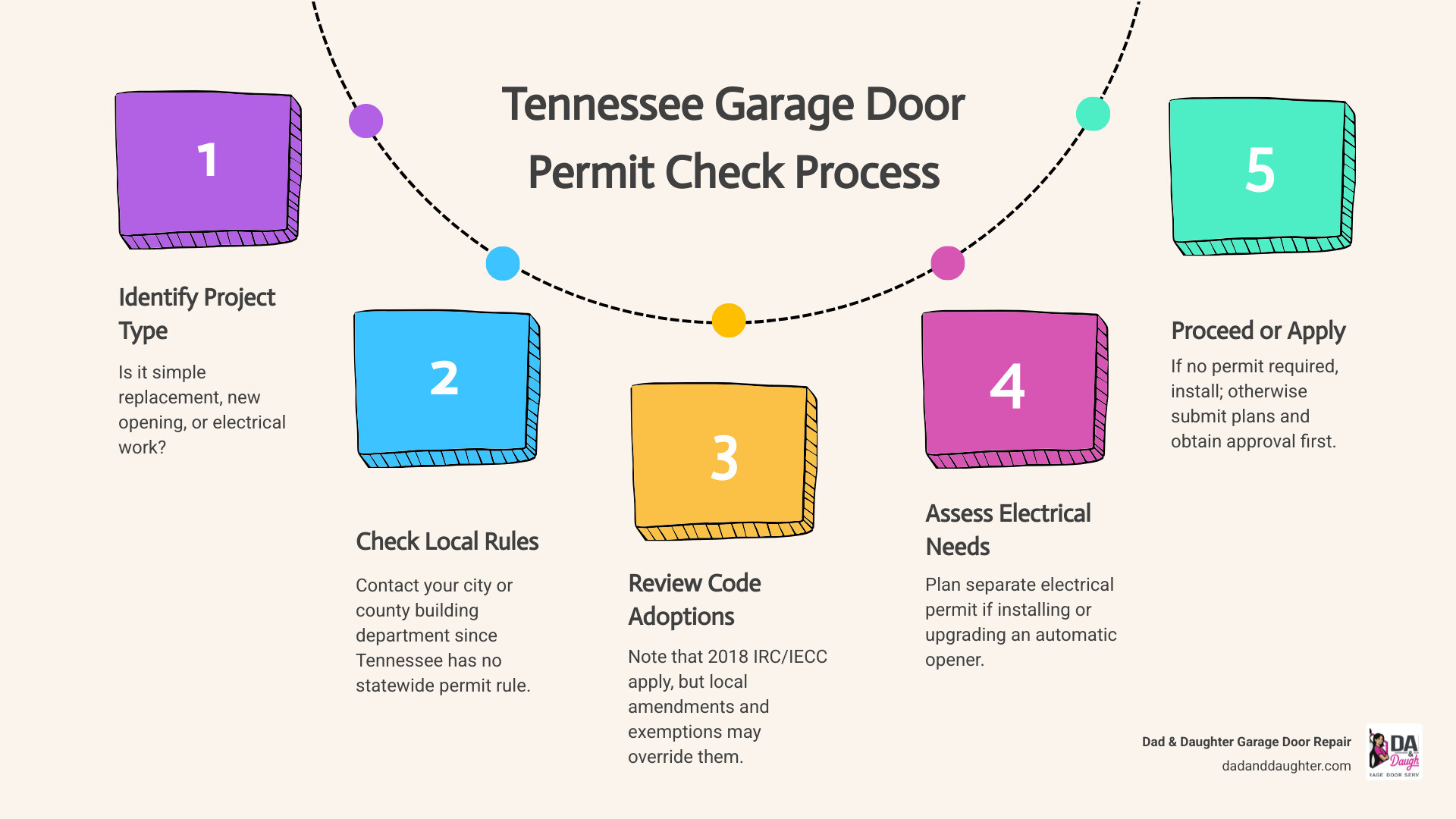
Do you need a permit to install a new garage door in Tennessee? The short answer depends on your city, the scope of the work, and whether the door opening is changing. Here is a quick breakdown:
- Simple replacement, same opening size: In most Tennessee jurisdictions — including Nashville for 1-2 family dwellings — replacing a garage door without altering the opening does not require a building permit.
- New garage door opening or structural change: A permit is very likely required regardless of your city.
- Electrical work for a new opener: A separate electrical permit is typically required across Tennessee.
- New garage construction: A building permit is required in nearly every incorporated Tennessee city.
Tennessee’s permit rules are not set at the state level for projects like this. Your local city or county building department has the final say — and the rules can look very different depending on whether you live in Nashville, Memphis, Knoxville, or a rural unincorporated county.
This guide walks you through exactly how to check what applies to your specific project so you can move forward with confidence and avoid costly surprises.
Do You Need a Permit to Install a New Garage Door in Tennessee?
When you look at the state level, Tennessee’s building code system can seem a bit like a jigsaw puzzle. The state has adopted the 2018 International Residential Code (IRC) and the 2018 International Energy Conservation Code (IECC) as its baseline standards. Under the State Fire Marshal’s Office (SFMO), detached structures like garages, sheds, and barns that are not used as living spaces are actually exempt from state-level residential building permits.

However, this state-level exemption rarely applies to your average homeowner. Why? Because Tennessee law allows local municipalities and counties to establish their own local building departments and enforce stricter local codes. Most incorporated cities have done exactly that.
If you are planning to install a new garage door, the need for a permit hinges on three key factors:
- Structural Modifications: If we are simply taking out your old, worn-out door and putting a beautiful new one in its place without altering the wood framing, header, or size of the opening, you generally do not need a building permit. But if we have to enlarge the opening, raise the header, or change a double-door system into two single doors, you are altering the load-bearing structure of your home. This type of work absolutely requires a building permit.
- Attached vs. Detached Garages: If you are building a new garage or converting an existing space, attached garages always require permits because they share a structural wall and fire barrier with your main living space. Detached garages over a certain square footage also require permits in almost every Tennessee municipality.
- Zoning and Local Overrides: Local municipal governments have the final authority. If you live inside the city limits of Nashville, Chattanooga, or Knoxville, you must follow their specific municipal matrices, which often override state-level exemptions.
Before you make any purchases, it is vital to understand your local town’s specific rules. For a detailed step-by-step breakdown on how to navigate this verification process, check out our guide on How to Check if You Need a Permit to Install a Garage Door in Tennessee.
How Local Rules Vary Across Major Tennessee Cities
Because local governments hold the reins, building regulations vary wildly across the state. In some rural unincorporated areas of Tennessee, local governments have voted to opt out of state building codes entirely, meaning you might not need a permit for almost any residential project. But if you live in one of our main metropolitan service areas, the rules are strictly enforced.
The table below outlines how permit requirements, review timelines, and rules vary across major urban areas in Tennessee:
| City | Permit Needed for Door Replacement (No Structural Change)? | Permit Needed for New Garage Construction? | Average Permit Review Timeline | Key Local Rule / Code Edition |
|---|---|---|---|---|
| Nashville | No (for 1-2 Family Dwellings) | Yes (if over 100 sq. ft.) | 10 to 15 business days | Adopted 2024 International Codes in mid-2025 |
| Knoxville | No (if opening is unchanged) | Yes (any size inside city limits) | 5 to 10 business days | City limits require permits for all detached garages |
| Chattanooga | No (if opening is unchanged) | Yes (if over 120 sq. ft.) | 5 to 10 business days | Land Development Office regulates zoning and setbacks |
| Memphis | No (if opening is unchanged) | Yes (any size structure) | 7 to 20 business days | Strict seismic compliance rules for structures over 400 sq. ft. |
Beyond building permits, local zoning laws and Homeowners Association (HOA) rules play a massive role in garage door installations. For example, if you are building or expanding a garage, you must comply with local setback rules (the distance the structure must sit from your property lines).
In Nashville, detached garages under 700 square feet can sometimes take advantage of reduced 3-foot side and rear setbacks if they sit entirely behind the main house. However, an HOA can enforce even stricter aesthetic guidelines, such as requiring specific door materials, colors, or window designs to match the neighborhood’s character. Always secure written HOA approval before applying for a city permit.
Nashville: Do You Need a Permit to Install a New Garage Door in Tennessee for 1-2 Family Dwellings?
If you live in the Nashville metro area, your project falls under the jurisdiction of the Metro Nashville Department of Codes & Building Safety. Nashville is known for having some of the most comprehensive local building codes in the state. In fact, Nashville officially adopted the 2024 International Codes in mid-2025, making it one of the very first cities in Tennessee to move past the older 2018 standards.
For homeowners living in standard one- and two-family dwellings, Metro Nashville Codes provides a very clear exemption: you do not need a building permit to replace a garage door as long as the structural opening does not change.
This means if we are upgrading your home’s curb appeal with a modern insulated steel door or a classic carriage-house style door, and we are using the existing door frame, we can get to work immediately without waiting on Metro Codes.
However, if you are building a brand-new detached garage, a permit is required for any accessory structure that is 100 square feet or larger. Additionally, if you plan to convert an existing garage into a livable space (like a home office or a detached accessory dwelling unit), you will need a comprehensive building permit to ensure the space meets modern energy, ventilation, and fire-safety codes.
For those navigating new construction or major renovations in the area, we highly recommend reading The Definitive Guide to Garage Door Options for Nashville New Construction to make sure your project aligns perfectly with local styles and structural rules.
Memphis, Knoxville, and Chattanooga: Do You Need a Permit to Install a New Garage Door in Tennessee?
Moving outside of Middle Tennessee, let’s look at how other major municipal hubs handle these requirements.
Knoxville
If you are located in East Tennessee, Knoxville’s local rules require building permits for any new garage construction within the city limits, regardless of its size. If you live in the unincorporated areas of Knox County, a permit is only required for detached garages over 120 square feet.
For simple garage door replacements where the structural opening remains exactly the same, Knoxville does not require a permit. The local review time for residential building permits is relatively fast, averaging about 5 to 10 business days.
Chattanooga
In Southeast Tennessee, Chattanooga’s Land Development Office regulates residential building. Similar to Knoxville, Chattanooga exempts simple, non-structural garage door replacements from permit requirements.
However, if you are constructing a new detached garage, any structure over 120 square feet will require a building permit. Chattanooga requires strict adherence to foundation standards, ensuring that any garage slab is poured on a solid, reinforced concrete foundation that extends below the local frost line (which sits at about 12 to 18 inches in Middle and East Tennessee).
Memphis
Though outside our primary service areas, it is worth noting that West Tennessee has unique geographic requirements. Because of its proximity to the New Madrid Seismic Zone, Memphis and Shelby County require strict seismic compliance reviews for any new garage or accessory structure over 400 square feet.
Additionally, Shelby County enforces a strict penalty system: they will automatically double your permit fees if any construction work is started before the official permit is issued.
Key Requirements and Additional Permits for Garage Door Projects
While a simple door swap might not require a building permit, there are several secondary requirements, electrical codes, and licensing rules you must keep in mind to keep your home safe and compliant.
Electrical Permits and GFCI Requirements
Are you planning to install a brand-new automatic garage door opener along with your new door? If your garage does not already have an electrical outlet near the ceiling to power the opener, you will need to run new electrical wiring.
Under Tennessee state law, all new electrical installations require an electrical permit and must be inspected by a certified electrical inspector. Furthermore, the International Residential Code (IRC) mandates that every garage must have at least one GFCI-protected (Ground Fault Circuit Interrupter) receptacle. If you are adding an electric vehicle (EV) charger or high-voltage workshop outlets during your garage upgrade, these will also require separate trade permits and dedicated circuits.
Contractor Licensing in Tennessee
Before hiring anyone to work on your home, it is crucial to understand the state’s licensing laws:
- Projects under $3,000: No state-level contractor license is required.
- Projects between $3,000 and $24,999: A Home Improvement Contractor License is required in many Tennessee counties. This license ensures the contractor is registered, bonded, and carries proper liability insurance.
- Projects $25,000 and over: A full Licensed General Contractor is required to pull permits and oversee the work.
If you plan to perform the work yourself, many jurisdictions allow for “owner-builder self-permits.” However, as a self-permit holder, you assume 100% of the legal and physical liability for code compliance.
Given that garage doors operate under extreme spring tension — capable of causing severe injury or structural damage if installed incorrectly — hiring a licensed, insured professional is always the safest route.
For a complete breakdown of what to look for when choosing a remodeling partner, read our A Z Guide to Choosing a Garage Door for Your Home Remodel in Middle Tennessee.
Frequently Asked Questions About Tennessee Garage Door Permits
How long does it take to get a garage door permit approved in Tennessee?
For standard residential projects that require a permit (such as a new garage build or structural alteration to a door opening), the approval process usually takes about 5 to 10 business days across most of Tennessee.
If you are dealing with the Metro Nashville Codes Department, the review times can take slightly longer, averaging 10 to 15 business days due to the high volume of local construction. To avoid unnecessary delays, ensure that your application includes a clear, scaled site plan showing exact property lines, easements, and the structural drawings of the proposed door frame changes.
What happens if you install a garage door without a permit in Tennessee?
If you perform structural modifications or build a new garage without obtaining the required municipal permits, the consequences can be severe:
- Stop-Work Orders: Code enforcement officers can immediately halt your project, leaving your garage exposed to the elements.
- Financial Penalties: Most local jurisdictions, including Nashville and Chattanooga, will charge double the permit fee as a penalty for unpermitted work.
- Forced Removal: In extreme cases, if the structural changes do not meet local safety or zoning setback codes, you may be legally forced to tear down the work and start over.
- Real Estate Complications: Unpermitted home improvements often resurface during home inspections when you try to sell your property, potentially stalling or ruining the sale.
Do I need a licensed contractor to install my garage door in Tennessee?
While homeowners are legally allowed to pull self-permits for their primary residence, it is highly discouraged for garage door installations. Because garage doors rely on high-tension torsion springs to counterbalance hundreds of pounds of steel or wood, improper installation can lead to catastrophic failure, property damage, or severe bodily harm.
Hiring a local professional who understands local wind-load requirements, structural headers, and electrical safety is always the best decision. For practical tips on vetting local companies, take a look at our A Practical Guide to Choosing Garage Door Installers in Middle Tennessee.
Conclusion
Navigating the local building codes in Tennessee doesn’t have to be a headache. To summarize: if you are simply replacing an old garage door with a beautiful new one and keeping the opening the exact same size, you do not need to worry about pulling a building permit in Nashville or our surrounding communities. However, if you are planning a larger structural remodel, running new electrical lines, or building a brand-new garage, staying compliant with local codes is essential to protecting your home’s value and safety.
At Dad & Daughter Garage Door Repair, we have been helping Tennessee homeowners navigate these exact decisions since 1996. As a family-owned, locally operated business without private equity backing, we take pride in delivering honest advice, exceptional craftsmanship, and consistent customer care.
Whether you need a quick repair or a complete replacement, we proudly serve homeowners across the region, including:
- Nashville
- Smyrna
- Franklin
- Murfreesboro
- Knoxville
- Chattanooga
- Brentwood
- Spring Hill
- Mt. Juliet
- Lebanon
- Gallatin
- Hendersonville
- Nolensville
- La Vergne
- Bellevue
- Thompson’s Station
- Old Hickory
Are you ready to elevate your home’s curb appeal with a professionally installed, code-compliant garage door? Contact us today or visit our Garage Door Installation Nashville Area page to schedule your consultation!
Need Help?
Contact us today to discuss your needs. Our team is ready to help.
About the Author
Dad And Daughter Garage Door Service
More Articles
View All PostsRelated Articles

Why Nashville Building Codes Dictate Specific Wind Load Ratings
An unbraced garage door is the largest structural vulnerability during severe weather. See exactly what local inspectors look for to ensure your new build meets current wind load requirements.
Read Article
The Cost Difference Between Stamped Steel and Custom Wood Doors
Choosing between custom wood and steel means looking past the initial estimate. Understand the lifetime maintenance realities of each material before your next exterior upgrade.
Read Article
Preparing Your Commercial Warehouse Doors for Winter Deliveries
September is the critical window to secure your loading docks before freezing temperatures cause mechanical failures. Learn how to address degraded hardware and protect your Q4 shipping schedule.
Read ArticleReady to Get Started?
Whether you need a repair, maintenance, or a new installation, our expert team is here to help.