How to Diagnose Failing Garage Door Rollers
Dad And Daughter Garage Door Service

Learn how do you know if your garage door rollers need replacing with visual signs, sounds, and expert tips.
How to Diagnose Failing Garage Door Rollers
How Do You Know If Your Garage Door Rollers Need Replacing Before Bigger Problems Start
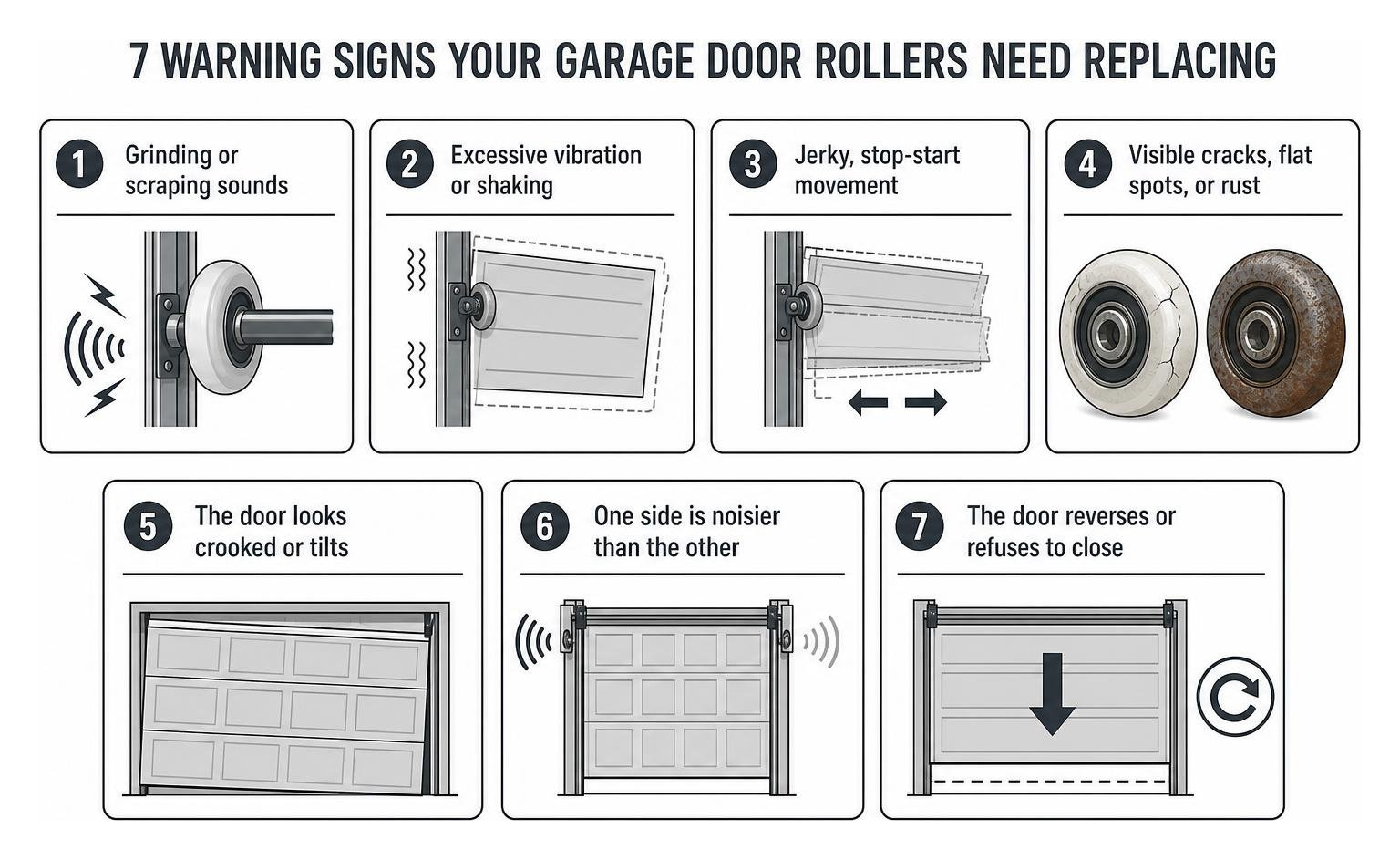
How do you know if your garage door rollers need replacing? Here are the most common signs to watch for:
- Grinding or scraping sounds during opening or closing
- Excessive vibration or shaking as the door travels
- Jerky, stop-start movement instead of smooth travel
- Visible cracks, flat spots, or rust on the roller wheels
- The door looks crooked or tilts as it moves
- One side is noisier than the other
- The door reverses or refuses to close even when sensors are clear
If you notice any of these, your rollers are likely worn and due for inspection or replacement.
Your garage door opens and closes roughly 1,000 to 1,500 times a year. Every single one of those cycles puts stress on a set of small wheels called rollers — and most homeowners never think about them until something goes wrong.
It usually starts subtle. A grinding sound on the first opening of the morning. A little more vibration than you remember. Then the door starts moving unevenly or hesitating mid-travel. By that point, worn rollers may already be putting extra strain on your opener, your tracks, and your springs.
The good news is that rollers give plenty of warning signs before they fail completely — and catching them early keeps a simple fix from turning into a costly repair. This guide from Dad & Daughter Garage Door Repair walks you through exactly what to look and listen for.
What Are Garage Door Rollers and Why Do They Wear Out?
To understand when rollers need to be swapped out, it helps to understand what they actually do. Think of your garage door rollers as the joints of your garage door system. Just like the joints in your body allow your limbs to move smoothly, rollers allow the heavy panels of your garage door to transition from a vertical hanging position to a horizontal overhead position.
A typical residential garage door in Nashville or Brentwood uses 10 to 12 rollers depending on its height (a standard 7-foot door uses 10, while an 8-foot door requires 12). Each roller consists of a wheel attached to a metal stem. The stem slides into a hinge bracket on the side of the door panel, while the wheel sits inside the metal track.
As the garage door opener pulls the door upward, these wheels roll along the track assemblies, distributing the door’s weight (which can range anywhere from 80 to 200 pounds) and reducing friction.
However, because these rollers are weight-bearing parts that must perform under pressure without getting a chance to “warm up,” they naturally degrade over time. The main causes of roller wear include:
- Continuous Cycling: The average residential door cycles 2 to 4 times a day. Over several years, this adds up to thousands of rotations, slowly wearing down the wheel material and internal bearings.
- Dirt and Grit Accumulation: Tracks naturally collect dust, pet hair, and wind-blown grit. This debris acts like sandpaper inside the roller bearings, grinding down the moving parts.
- Inadequate Lubrication: When rollers run dry, the metal-on-metal friction inside the bearings accelerates wear, leading to seized wheels.
- Environmental Factors: High humidity and temperature swings in Middle Tennessee can cause metal rollers to rust and cheap plastic rollers to warp or crack.
When rollers begin to fail, they stop rolling and start sliding. This sliding creates extreme friction, which can damage your tracks and put immense strain on your entire system. Keeping up with regular Garage Door Service Maintenance Thompsons Station TN is the best way to catch this friction before it ruins other parts of your door.
Why Bottom Rollers Wear Out Faster Than Middle and Top Rollers
If you inspect a worn-out garage door, you will almost always find that the bottom rollers are in much worse shape than the middle and top rollers. This is not a coincidence; it is a matter of physics and mechanical design.
The bottom rollers sit in the bottom brackets, which serve as the anchor points for the door’s heavy lift cables. These cables are under extreme tension from the garage door springs. Because of this, the bottom rollers bear the brunt of the initial “pull” when the door starts to open.
Furthermore, the bottom rollers experience the highest side-load stress. As the door transitions from vertical to horizontal, the bottom rollers handle the pivot load, acting as the primary stabilizer for the bottom section of the door. Because they are closest to the ground, they are also exposed to more dirt, moisture, salt, and debris swept in from the driveway, accelerating rust and bearing failure.
How Do You Know If Your Garage Door Rollers Need Replacing?
Recognizing the signs of failing rollers is crucial to preventing a complete system breakdown. When rollers fail, they do not just make noise; they can cause the door to jump out of its tracks, damage the track surface, or burn out your garage door opener motor.
If you suspect your rollers are on their last legs, the first step is to isolate the issue. You can do this by disconnecting your automatic opener (by pulling the red emergency release cord) and operating the door manually. If the door feels exceptionally heavy, catches at certain points, or makes a scraping noise even when moved by hand, the rollers or tracks are likely the issue. If the door moves smoothly by hand but struggles under power, the issue might lie with the opener itself or your springs. You can learn more about isolating spring-related issues in our guide on How to Diagnose Garage Door Spring Issues.
Let’s break down the specific visual and auditory warning signs that tell you it is time to replace your rollers.
Visual Warning Signs: How Do You Know If Your Garage Door Rollers Need Replacing by Looking at Them?
You do not need to be a professional technician to spot physical damage on your rollers. A quick visual inspection every six months can reveal the following red flags:
- Hairline Cracks and Chipping: This is especially common in plastic or vinyl rollers. Look closely at the outer wheel. If you see cracks deeper than a quarter of the material thickness, the wheel is at risk of shattering.
- Flat Spots: If a roller bearing seizes, the wheel stops spinning and is dragged along the track. This wears a flat spot into the wheel, preventing it from ever rolling smoothly again.
- Loose Stems and Excessive Play: Grab the stem of the roller and try to wiggle the wheel. While there should be a tiny amount of play (about 1/16 to 1/8 of an inch), the wheel should not wobble loosely or feel like it is about to separate from the stem. If the bearing housing is cracked, the wheel can slide completely off.
- Rust and Corrosion: Metal rollers are highly susceptible to rust, especially in humid climates. Rust eats away at the ball bearings, causing them to lock up.
- Residue and Shavings: Look inside your tracks. If you see a trail of black smudges, metal shavings, or plastic dust, your rollers are actively grinding away against the track walls.
Auditory Warning Signs: How Do You Know If Your Garage Door Rollers Need Replacing by Listening?
Your garage door will often tell you it has a problem long before you see it. When rollers begin to wear out, they produce distinct noises that change as the damage progresses:
- Squeaking and Grinding: This is the classic sound of dry or worn bearings. It indicates that the lubrication has failed and the metal bearings are grinding against each other.
- Clacking and Rattling: If you hear a distinct “clack-clack” at the same spot during every cycle, a roller wheel likely has a flat spot or a cracked housing that is hitting a track joint.
- Scraping Noise: This occurs when a roller has completely seized. Instead of rolling, the wheel is sliding along the track, scraping away the protective galvanized coating on the steel.
- Trackside Friction: If the noise is coming directly from the vertical or horizontal tracks rather than the overhead motor unit, your rollers are struggling to guide the door.
If your door has started sounding like a freight train rolling through your garage, it is time to check out our Garage Door Repair Tips Gallatin TN to restore peace and quiet to your home.
Comparing Roller Materials: Plastic vs. Steel vs. Nylon
When it comes to replacing your rollers, you have options. Most builders install the cheapest possible rollers to save on construction costs, but upgrading to a higher-quality material can dramatically improve your door’s performance and lifespan.
Here is a comparison of the three most common roller materials used in residential homes:
| Feature | Plastic Rollers | Steel Rollers | Nylon Rollers |
|---|---|---|---|
| Average Lifespan | 2 to 3 years | 5 to 7 years (up to 20 years for heavy-duty) | 10 to 20 years (sealed bearings) |
| Cycle Rating | 3,000 to 5,000 cycles | 10,000 to 15,000 cycles | 10,000 to 20,000+ cycles (up to 100,000+) |
| Noise Level | Moderate to High | Very High (metal-on-metal) | Extremely Low (quietest option) |
| Maintenance | None (disposable) | High (requires frequent lubrication) | Low to None (sealed bearings) |
| Durability | Low (prone to cracking) | High (handles heavy doors) | High (tough and rust-resistant) |
| Ball Bearings | None (solid plastic wheel) | Open or exposed bearings | Sealed or precision ball bearings |
Let’s look at these materials in more detail:
- Plastic Rollers: These are the standard rollers found on many newly built homes. They have no internal ball bearings, meaning the plastic wheel spins directly on the metal stem. They wear out quickly, warp easily under heat, and offer very little noise reduction.
- Steel Rollers: Steel rollers are incredibly durable and can handle heavy wood or double-car steel doors. However, they are incredibly noisy because they run metal-on-metal inside the steel tracks. They also require frequent lubrication to prevent rust and bearing failure.
- Nylon Rollers: Nylon is the gold standard for residential garage doors. They feature a tough nylon wheel molded over a ball-bearing core (usually containing 10 to 13 precision bearings). Nylon rollers glide silently through the tracks, absorb vibrations, and do not rust. Choosing high-quality nylon rollers is one of the easiest ways to quiet down an older door, as discussed in our Garage Door Repair Guide Spring Hill TN.
Safe Inspection and Maintenance Tips to Extend Roller Lifespan
You do not have to wait for your rollers to fail to take action. A simple maintenance routine performed twice a year can double the lifespan of your rollers and keep your door operating safely. Follow these steps to keep your rollers in top shape:
- Clean the Tracks First: Before applying any lubricant, take a damp cloth and wipe out the inside of your tracks. Removing dirt, pet hair, and old grease prevents the new lubricant from turning into a sticky, abrasive paste.
- Use the Right Lubricant: Never use WD-40 or heavy grease on your garage door rollers. WD-40 is a solvent and degreaser, not a long-term lubricant; it will actually strip the remaining grease out of your bearings. Instead, use a high-quality silicone-based spray or white lithium grease.
- Apply Lubricant Properly: Spray a thin coat of silicone lubricant directly into the ball bearings of each roller. If you have nylon rollers with exposed bearings, a quick spritz is all they need. If you have sealed nylon rollers (often called Z-bearing rollers), they are permanently lubricated and do not require any maintenance! Avoid spraying the outer surface of nylon wheels, as this can cause them to slip rather than roll.
- Tighten Loose Hardware: Over time, the vibrations of the door opening and closing can loosen the hinges holding your rollers in place. Use a wrench to snug up any loose bolts, but be careful not to over-tighten and strip the sheet metal.
- Test the Safety Features: While performing maintenance, always ensure your door’s safety sensors and auto-reverse mechanisms are working correctly. You can follow our Ultimate Checklist for Garage Door Safety Features to make sure your family and pets remain protected.
Why Professional Replacement is the Safest Choice
While some middle and top rollers can technically be replaced by a handy homeowner, attempting a full DIY roller replacement carries significant risks.
The primary danger lies in the bottom brackets. As mentioned earlier, the bottom brackets are directly connected to the garage door’s lift cables, which are under immense tension from the torsion springs. If you loosen the bolts on a bottom bracket without properly securing the spring tension, the bracket can fly off with enough force to cause severe injury or property damage.
Additionally, replacing rollers incorrectly can lead to:
- Bent Tracks: Forcing a roller out of the track without the proper tools can bend or warp the metal track, leading to rough operation or door jams.
- Unbalanced Doors: If the hinges are not reinstalled in the exact correct position, the door can become misaligned, putting uneven wear on your springs and opener.
- Warranty Voiding: Many garage door manufacturers void their warranties if repairs are performed by unlicensed individuals.
By hiring our experienced team at Dad & Daughter Garage Door Repair, you ensure the job is done safely and correctly. We replace your rollers using professional-grade tools, inspect your tracks for alignment issues, and perform a comprehensive safety check on your entire door system. To see what a professional repair entails, check out our Garage Door Repair Solutions Thompsons Station TN.
Frequently Asked Questions About Garage Door Roller Replacement
How long do garage door rollers typically last?
The lifespan of your rollers depends heavily on the material they are made of, how often the door is used, and how well they are maintained. On average, basic plastic rollers last about 2 to 3 years. Standard steel rollers with open bearings usually last 5 to 7 years. High-quality nylon rollers with sealed ball bearings can easily last 10 to 15 years, and in many cases, up to 20 years with proper maintenance. For more details on component lifespans, refer to our Garage Door Service Guide Gallatin TN.
Can I replace just one bad roller or should I replace the whole set?
While you can technically replace a single broken roller, we always recommend replacing the entire set at once. Rollers wear out at a similar rate because they experience the same number of cycles. If one roller has failed, the others are likely close behind. Replacing them as a complete set ensures balanced door travel, prevents uneven track wear, and saves you from scheduling multiple repair visits. Learn more about what to expect during a professional tune-up in our guide to Garage Door Service Expectations Spring Hill TN.
What happens if I ignore worn-out garage door rollers?
Ignoring worn rollers is a recipe for a much larger repair bill down the road. When rollers seize or wobble, they increase the friction the garage door opener must overcome. This extra resistance strains the opener’s motor and gears, leading to premature opener failure. Furthermore, seized rollers will scrape and gouge your tracks, eventually requiring a full track replacement. In the worst-case scenario, a broken roller can cause the door to fall completely off its tracks, posing a major safety hazard to anyone nearby.
Conclusion
Your garage door rollers may be small, but they play a massive role in keeping your home’s largest moving part operating smoothly, quietly, and safely. Knowing the physical and auditory warning signs of roller wear allows you to address the issue before it causes secondary damage to your tracks, springs, or opener.
If your garage door is shaking, grinding, or struggling to open, let our family handle yours. At Dad & Daughter Garage Door Repair, we have been serving the Nashville area since 1996. As a locally operated, family-owned business without private equity backing, we focus on delivering honest, consistent customer care to our neighbors in Smyrna, Franklin, Hendersonville, Brentwood, and beyond.
Do not let noisy, worn-out rollers ruin your morning routine. Contact us today to schedule your professional inspection and roller upgrade at our Garage Door Repair Nashville Area page, and let us bring peace and quiet back to your garage!
Need Help?
Contact us today to discuss your needs. Our team is ready to help.
About the Author
Dad And Daughter Garage Door Service
More Articles
View All PostsRelated Articles

Why Nashville Building Codes Dictate Specific Wind Load Ratings
An unbraced garage door is the largest structural vulnerability during severe weather. See exactly what local inspectors look for to ensure your new build meets current wind load requirements.
Read Article
The Cost Difference Between Stamped Steel and Custom Wood Doors
Choosing between custom wood and steel means looking past the initial estimate. Understand the lifetime maintenance realities of each material before your next exterior upgrade.
Read Article
Preparing Your Commercial Warehouse Doors for Winter Deliveries
September is the critical window to secure your loading docks before freezing temperatures cause mechanical failures. Learn how to address degraded hardware and protect your Q4 shipping schedule.
Read ArticleReady to Get Started?
Whether you need a repair, maintenance, or a new installation, our expert team is here to help.